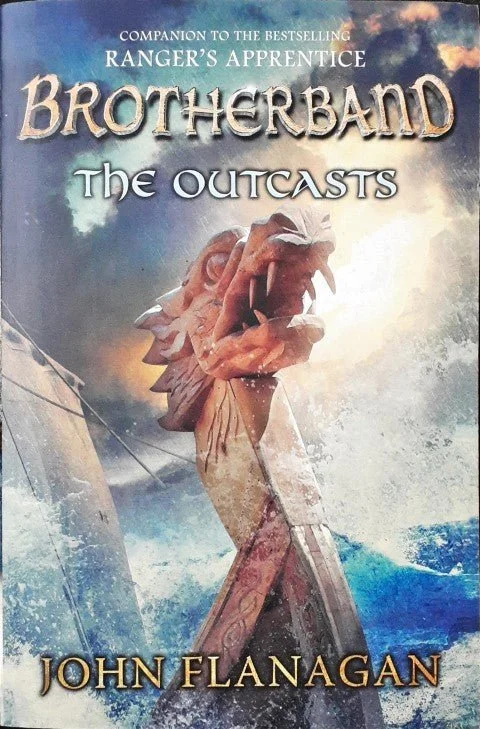
Brother Band: Outcasts
by John Flanagan
Reading schedule
Week 17 - January 13, Read through chp 12 (roughly 1/4 of the book)
Week 18 - January 20 - Read through chp 22, (roughly 1/2 of the book)
Week 19 - January 27, Read through chp 33 (roughly 3/4 of the book
Week 20 - February 3, Finish the book
Week 21 -Culminating Activities and writing projects
Week 22 - Culminating Activities and writing due
Weekly Assignments by Ms. Lisa
January 13, 2026 Week 17 Characterization
Read through chp 12
As you read, choose one character on which to focus. You will be filling out a characterization chart on this character as homework.
Consider: How does the author reveal what that character is like? Look for the following ways the author characterizes him or her and mark these passages:
Narrator’s words about the character
Other characters words or thoughts about the character
Character’s own words (can be thoughts or dialogue)
Character’s own actions
Other characters actions or reactions to that character
If you’ve already read the entire book, go back and skim the first 1/4 of it and look for passages about one particular main character.
Add some passages you’ve found to our Characterization Chart CHARACTERIZATION CHART (MS Word Doc) PDF HERE. You do not yet have to fill in the symbols section, but be thinking about a symbol that could represent that character trait.
January 20, Week 18
Deeper Meaning - Analyze one Quotation
Read through chp 22
Finish the Above and Below Ground Form which we started in class. On the back side of that handout, draw an illustration of the what the quotation you chose means.
Write two discussion questions about these chapters. Your questions should be open ended so you can have an interesting conversation with your small group.
Book mark at least one passage that is an example of great writing that YOU like.
January 27, Week 19
Character Development
Read through chp 33
Write two discussion questions about these chapters. Your questions should be open ended so you can have an interesting conversation with your small group.
Then work on your characterization chart —see details below.
Character Development
Option A:
Add to your CHARACTERIZATION CHART (MS Word Doc) — from Week 17 if you’ve found new interesting evidence. On the back of your characterization chart address the questions listed below.
Is your character:
dynamic or static?
round or flat?
What additional evidence from the book supports your claim about whether or not your character is dynamic or static, round or flat? Find at least one passage that backs up your argument.
Option B:
Create a Venn diagram comparing two characters in the novel
Is each character:
dynamic or static?
round or flat?
What additional evidence from the book supports your claim about whether or not your character is dynamic or static, round or flat? Find at least one passage that backs up your argument. Write that evidence on the back of your Venn Diagram
February 3, Week 20
Start Culminating Activities
Finish the book
Add symbols to your characterization chart.
Choose a culminating activity from brown box below. Begin ruminating about it— start planning what you’ll do. You’ll start working on it IN CLASS next week. So bring whatever supplies you need for it.
February 10, 2026 Week 21
Prepare for your in-class essay or paragraph
Make an outline for a characterization paragraph/essay to be written in class.
You have two writing prompt options:
Write about two character traits possessed by one character. Why do these traits matter (do they drive the plot? relate to a theme? serve as a foil to another character? OR
Compare and contrast two characters. Why do their differences and similarities matter?
It will be a double, double hamburger paragraph format. OR if you want more space, you may write a five-paragraph essay
Formatting rules are: no more than five paragraphs and two pages double spaced, 12 point Times New Roman, Palantino, or Garamond font, 1 inch margins. Again, we will write this in class next time we have class. Bring a lap top. You’ll email me your work from class and you’ll turn in your outline which you did at home.
Culminating Activities
Choose one.
WE ARE DOING THIS ONE IN CLASS AS TEAMS. PICK A DIFFERENT CULMINATING ACTIVITY FOR YOUR INDIVIDUAL PROJECT. Create a 3/4 life size poster of a character from the novel. We call this a character collage. Illustrate them with symbols of their character traits and write quotations from the novel which reveal that trait.
Illustrated quotations. Choose three important quotations from the novel which reveal something important about a main character, topic, or theme of the novel. What do each of these quotations reveal? Create drawings to go with each quotation.
Create a public service poster warning of the dangers of ________________________. What are examples of how _____________________ affects _________________.
Character development via comic strip. Draw a comic strip or poster showing how the character changes over time if at all. Is he a flat or round character? A static or dynamic character? Your comic strip should show the character at three different points in time. Consider: What does he or she learn about themself?
Create a presentation on heroism. How does this novel portray heroism. How do other books, movies, news and popular culture traditionally depict heroes? Do you think it matters if a person’s actions are intentially heroic or accidentally heroic? Include these ideas in your presentation and tie them to the novel.
Create a poster or essay or comic strip about power. How is power portrayed in this novel? Which characters or cultures use their power to take what they want versus using their power to influence others to negotiate or compromise or form partnerships? When is each use of power justified (if it is)? Are their historical or current event examples of individuals or nations wielding power in these ways: take what one wants because one is stronger vs. using influence to form partnerships? What do you value & why?
Create a poster or essay about self-knowledge and how that is a form of power. Consider how acknowledging our weaknesses or our less admirable tendencies gives us power. How does a main character understand themselves better by the end of the novel? What role does their self-knowledge play in helping them succeeding?
Create a poster or write an essay about contrasts or opposites in the novel. Who or what are contrasted starkly in the novel? Find quotations in the novel about these ideas.
Created by Lisa Clark-Burnell