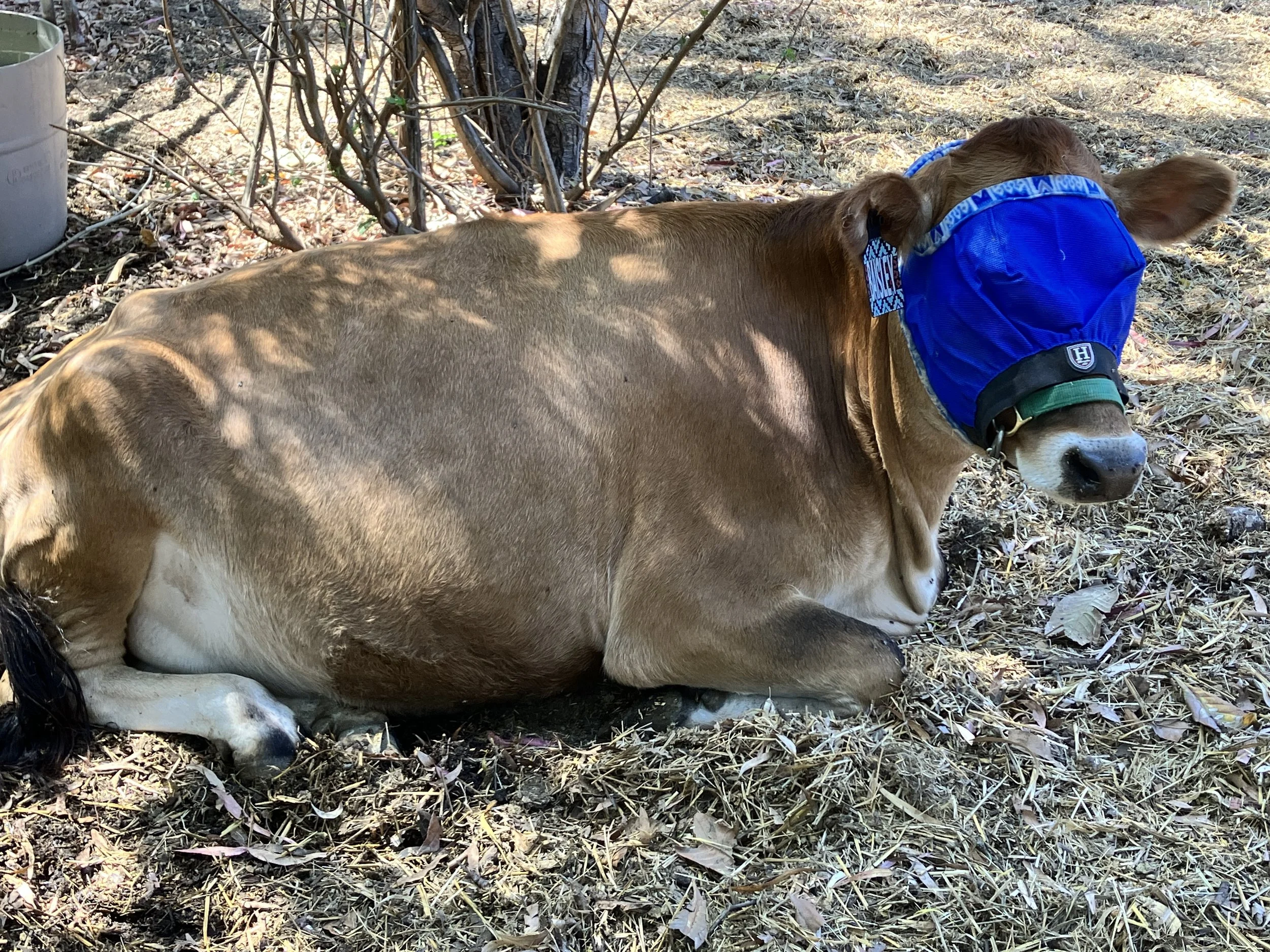
Milk Share
Wholesome A2/A2 milk from happy cows.
Raw. Cream on the top. A2/A2.
How our members get milk
All the details.
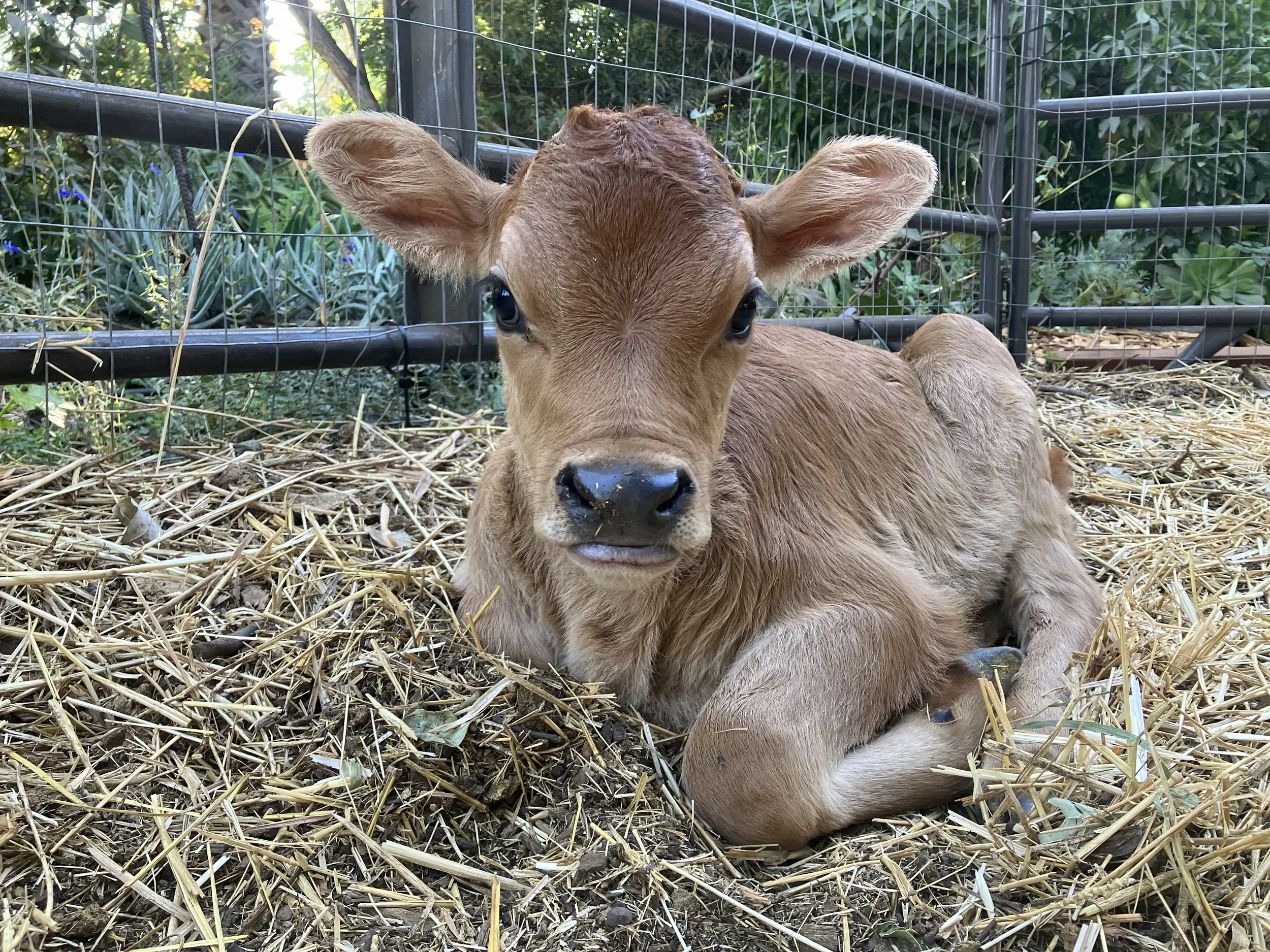
-
PRICE PER GALLON IS $20
plus
ONE TIME PRIVATE MEMBERSHIP ASSOCIATION (PMA) FEE — this is paid the first time you pick up milk.
You must be a member of our Private Membership Association in order to get raw milk.
½ gallon every week = $20 one-time membership fee
1 gallon every week = $30 one-time membership fee
1.5 gallons every week = $40 one-time membership fee
2+ gallons every week = $50 one-time membership fee
After purchasing your PMA milkshare membership, you can get that amount of milk each week.
So, if you are getting ½ gallon a week, you will pay your membership fee just once, then $10 per ½ gallon. This is paid on a monthly subscription basis. If your pick up day is Monday and their are 4 Mondays in May, then you pay $40 upfront on May 1st.
You must be a member of our Private Membership Association in order to get raw milk.
You order your milk for each month and pay at the beginning of the month. Your milk will always be ready at 8 a.m. on your pick up day.
You’ll pay your one time private membership fee the first month. First month will look like this:
Sample: 1 gallon every week for 4 weeks = $20 × 4 = $80 + one time private membership association fee of $30 = $110 total for the first month only
Every other month afterwards your month subscription order payment will be like this:
Subsequent months = $20 for one gallon each week × 4 weeks =$80
Or if there are 5 of your pick-up day (say your day is Friday and October has 5 Fridays) $20 × 5 pick up days= $100
Pay via Venmo or cash in an envelope in our locked mailbox (text Lisa & Viv for their Venmo info)
CONTACT US to become a Mt. Helix Milkshare PMA member.
Note - we have a full waitlist for PMA membership this cycle. You can still get on the waitlist for PMA membership for 2027. Gerti will only produce 60% of her full capacity this first lactation cycle. So we’ll have more milk in 2027 than we anticipate in for this year, 2026.
-
We’ll schedule your weekly pick-up day via text or phone call.
We spread out pick up days so the same amount of milk is being picked up daily.
Example:
If you have a ½ share and are picking up every week, and your day is Wednesday, on at the last Saturday of the month, month we’ll send you a text the link to the coming month’s milk schedule and your bill. If there are 4 Wednesdays you’ll owe $10×4 = $40.
If there are 5 Wednesdays that month you owe $10 × 5 = $50.
-
Once we reach out to you to let you know that you’re next on the list for getting milk, we’ll arrange a Farm Tour and you’ll read and sign the milk PMA agreement.
FARM TOUR: On the quick Farm Tour you’ll meet the cows, your dairy maids, and learn the ropes of picking up fresh milk.
MILKD PMA AGREEMENT: simple contract and liability waiver. PMA stands for Private Member Ship association.
MILK PICK UP OVERVIEW
First time, pay your one-time PMA subscription fee.
Every Saturday we post the milk pick up spreadsheet on the PMA Members page) so you can see your milk subscription for the month.
Pay for your month’s milk by the 1st.
Pick up fresh milk from the dedicated milk fridge.
Pick up times are 8:00 a.m. to 9:00 p.m. M, W, F, S, S. and Tuesday has limited pick up hours: 8 TO noon, 4 pm to 9 pm.
You have 36 hours to get your milk. (So if your day is Monday, you have until Tuesday 8 p.m. to pick it up.)
Color coded labels: Your milk will have a color coded label on the lid that says Monday or Tuesday or Wednesday, etc. And all milk for that day’s pick up will be in the same spot in the fridge. The day on the lid is the day it is to be picked up. Date milked is on a round sticker on the side.
Sign the clip board that you got your milk and write down the number of clean jars you returned. NO JARS, NO MILK, NO EXCEPTIONS.
Bring an insulated bag or chest with ice pack and a dish towel to cushion jars while you transport your milk home. All milk (raw and pasteurized) should stay below 40 degrees.
-
MILK PICK UP OVERVIEW
First time, pay your one-time PMA subscription fee.
On the last Saturday of the month, we’ll send out the milk pick up spreadsheet via text (and post it on the milk page) so you can see your milk subscription for the month.
Pay for your month’s milk by the 1st.
Pick up fresh milk from the dedicated milk fridge.
Pick up times are 8:00 a.m. to 9:00 p.m. M, W, F, S, S. and Tuesday & Thursdays have limited pick up hours: 8 TO 9 AM, 5 pm to 9 pm
You have 36 hours to get your milk. (So if your day is Monday, you have until Tuesday 8 p.m. to pick it up.)
Color coded labels: Your milk will have a color coded label on the lid that says Monday or Tuesday or Wednesday, etc. And all milk for that day’s pick up will be in the same spot in the fridge. The day on the lid is the day it is to be picked up. Date milked is on a round sticker on the side.
Sign the clip board that you got your milk and write down the number of clean jars you returned. NO JARS, NO MILK, NO EXCEPTIONS.
Bring an insulated bag or chest with ice pack and a dish towel to cushion jars while you transport your milk home. All milk (raw and pasteurized) should stay below 40 degrees.
TIPS FOR OPENING MILK JARS
Our jars are naturally vacuum sealed (warm milk from cow plunged into 0 degree freezer creates a vacuum seal, which keeps your milk fresh longer.) But this makes them hard to open if you don’t have really strong hands or a tool.
Run the lid under warm water or tap it.
Use a silcone gripper
Use a lever/opener like this
If that doesn’t work, ask us about bottling your milk in metal canning lids just for you.
-
Return empty, clean jars, and lids with gaskets to the lidded container next to next to the fridge.
HOW TO CLEAN THE JARS & GASKETS
Hand wash your jars to get off the cream that wants to stick to the sides.
Next, if you have a plastic lid, take the gasket out of the lid and wash the lids and gasket by hand. (If using a dishwasher, the top shelf is the best place for gaskets.
Keep track of your gaskets! We can’t buy replacement gaskets, so we have to buy entirely new lids if you lose the gasket.
Let the jar fully air dry before putting the lid on. Store the gasket at the bottom of the clean jar with the lid loosely on.
Smell test: your noses knows if the jar isn’t squeaky clean. If dirty it will smell like slightly sour milk.
After you return clean jars/lids, we thoroughly sanitize them a second time before refilling them with more goodness.
-
These farm rules are basic courtesy.
We spell these rules out because we’ve had folks wandering around the property, feeding the cows and returning filthy jars. 99% of folks don’t need be reminded to be considerate.
Go straight to the milk fridge. Bring a flash light and watch your step.
Supervise children. They may not play in our yard - not on the swings, or trampoline, or pick fruit. They stay by your side at all times.
Yes, say hi to the cows, by the milk fridge or the gap in the hedge.
Do not feed the cows.Do not pick up matter off the ground or pull leaves. Some plants - such as oleander - can kill a 1200 pound cow or horse will just one bite!
Do not put your hand through the fence to pet the cow. Over the fence is fine. Through the fence can lead to a broken arm if the cow throws her head to shake off a fly.
Do not touch gates, shed doors, water, feed etc.
Observe the pick up times. (8 am to 9 pm, except T & Th, which are 8 to noon am, then 4 to 9 pm)
Happy Cow + Healthy feed = Nutrient Rich Milk

-
Good news! We have sourced no and low spray alfalfa!!! This alfalfa has no pesticides and herbicides in fall, winter, and spring. Pesticides are only applied in summer. We have finally found a local importer to brings in his own loads of hay from Imperial Valley.
Alfalfa is full of protein, calcium, and potassium which a lactating cow needs to make milk. Alfalfa is sweet and cattle love it.
We also include a bit of low-spray oat hay, especially as she nears her dry time just before calving as she needs less potassium then. When we can get it, we source oat hay grown by FFA students at El Capitan HS.
-
We supplement her hay with daily tree forage from our organic property for a variety of micro-nutrients including phytophenols which provide powerful antioxidants to support her immune system. Fresh greens are also higher in vitamin A and beta-carotene.
Ursula especially likes loquat, grape, mulberry, banyan, Morton Bay fig, persimmon, acacia, and bamboo leaves.
We just planted 30 fruiting mulberry tree saplings around the property for the cattle too. When given a choice between fresh grass and mulberry leaves, Ursula chooses mulberry! It is rich in protein.
-
ORGANIC FRUIT
Our orchard produces pomegranates, pineapple guavas, citrus, persimmons, figs, loquats, mulberries, tropical guavas and more. We share this bounty with our cattle because it is nutritious and delicious. Fruit provides vital micro-nutrients, including anti-oxidants for the cow’s immune system, plus energy for milk production.
Ursula’s milking time treat is alfalfa, aloe leaves for an immune boost plus, fresh fruit and greens in season plus organic (that also means non-gmo) dairy pellets.
Her all-time favorite is autumn pomegranates; she will moo at you if she just gets one, because she wants 5! When pomegranate season is over she gets pumpkins, then pineapple guava, persimmons, then citrus, tropical guava, and in summer figs as the seasons progress. Ursula is teaching Gerti how to enjoy something other than just hay. While Gerti is still a less adventurous herbivore than her herd mate, she’s learning to like new fruits.
And this is how farmers used to do it; their cow turned their grass + orchard’s fallen fruit into milk or meat. That’s ruminant magic at work.
MICRO-PASTURES
We also have two micro-pastures of grasses, clovers, kale, pearl millet, sunflowers, oat, broccoli, and artichoke leaves which the cows get to graze every other week in spring, summer, and fall.
-
The modern dairy cow is not your grandma’s cow.
In 1911 the champion Jersey made an average of 3.3 gallons of milk per day.
In 2003 the champion Jersey made 14.3 gallons of milk a day.
In other words, the modern dairy cow is a Ferrari not a Ford. She needs high octane fuel otherwise she will literally milk herself to death.
Contrary to internet myths, one can not take a cow, like Ursula or Gerti, who is genetically predisposed to make 5-9 gallons of milk a day, and make her produce less milk by starving her and pretending she can live on just grass.
The modern purebred dairy cow cannot physically eat enough hay in a day to support the amount of milk she is producing. Her rumen (the fermentation chamber of her digestive system) is only so big!
This is why our dairy queens get grain in the form of dairy pellets. They are descended from fancy modern Jersey genetics and thus need the extra energy that the grain in their organic dairy pellet provides in order to be healthy.
The amount of grain/pellets our cows eat depends upon her body condition (how thin or fat she is) which depends upon how much milk she is making at that stage of her cycle.
Early lactation - 5 pounds of grain for breakfast and dinner.
Peak lactation - perhaps 8 to 10 pounds of pellets for breakfast and dinner.
Late lactation - 2 pounds a.m. and p.m.
What’s in her dairy pellet?
organic (non-GMO) ground grains,
minerals, vitamins,
and a touch of organic molasses.
We use this modest amount of organic dairy feed as medium for mixing in her vitamins, probiotics, and phytonutrient supplements (mostly sunflower seeds, brewer’s yeast, vitamin A, E, and essential oils) to ensure excellent health and to make sure she gets the energy needed to support her milk production.
We occasionally augment her organic grain with non-organic cracked or rolled wheat or oats or barley if she needs more calories to maintain her weight.
This modest amount of grain makes her a mostly grass-fed healthy cow.
This modest grain supplement does not significantly impact the ratio of omega 3 and omega 6 fatty acids in her milk.
Grain and Dairy Pellet Mix Ingredients list - all organic and NON-GMO
Kalmbach Organic Dairy 16% Protein Pellet
Nature Best Organic Cracked Corn
organic (non-GMO) cracked corn
Modesto Milling Non-Soy Lactating and Beef Cattle Feed- 15% protein
organic whole corn
organic wheat mill run
organic peas
organic whole wheat
organic sesame meal
ground limestone, hydrated sodium calcium aluminosilicate,
organic dried kelp
diatomaceous earth, salt, hydrolized yeast, zinc sulfate manganese sulfate
Vitamin E, sodium selenite,
vitamin A, D3, Calcium iodate, cobalt sulfate
Nature’s Best Dairy Cattle Pellet - 16% protein
organic grain by-products
organic plant protein
organic molasses
calcium carbonate, salt
organic soybean oil
monocalcium phosphate, calcium sulfate,
Vitamin E, magnesium oxide and sulfate, ground limestone, potassium sulfate, manganese sulfate, copper sulfate, selenium
cobalt carbonate, calcium iodate
Kalmbach Organic Dairy Mineral
Kalmbach Organic 16% Dairy Pellet
Custom locally milled organic, 16% non-soy + Fetrell mineral dairy pellet
-
Milk cows need a lot of calories to keep their weight up. We make sure they get enough carbs for energy and weight maintenance and protein for muscle and milk production. This means feeding additional grain during peak milk production.
We believe in sourcing as much local food as we can. So in addition to organic cracked corn, all-you can eat alfalfa and oats, perfectly balanced organic dairy cow pellets and minerals, we also feed spent brewers grain (SBG) from Societe Brewery in Kearny Mesa.
Spent brewers grain (SBG) is a terrific feed additive for cattle and a win-win for the environment. SBG would eventually be tossed in a compost bin by the brewmaster, but after fermentation has used up most of the sugars in the barley and hops to make beer, what is left is a highly nutritious source of protein (averaging 25-30% protein) and fiber. Perfect for a cow’s rumen! Gerti and Ursula can turn this SBG that might otherwise end up in a compost pile into energy and milk instead of eating corn shipped from across the country. This fits with our permaculture principles.
-
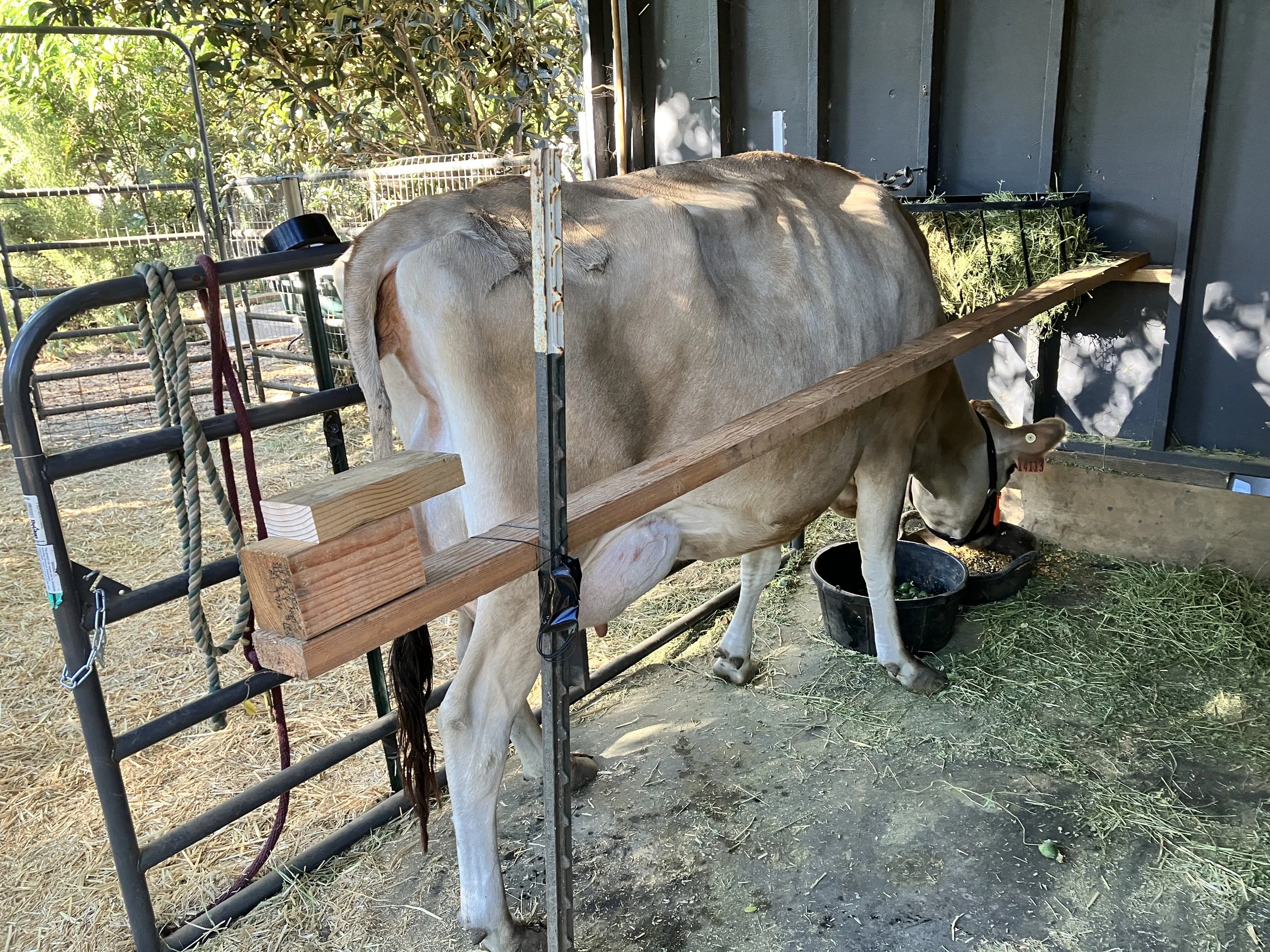
Dairy cows don’t look like beef cattle. They are angular, not muscular. You should be able to see ribs, pin and hip bones. It’s odd to the untrained eye!
According to Mississippi State University Ag Extension, “dairy character is determined by signs the cow can produce lots of milk. Excellent dairy character is shown by a great deal of angularity and openness, freedom from coarseness, and cleanness throughout.
Dairy animals should have a long, lean neck and sharp withers with no evidence of fat. The topline and rump show no fat, with the hip bones and pin bones sharply defined. Thighs should be thin and curve in, showing no excess fat. Skin should be thin, loose, and pliable.
Dairy animals should be open-ribbed and clean-cut at the throat, dewlap, and brisket.”
Raw milk tips

-
Transport your milk in an insulated grocery bag or small ice chest to keep milk cold. THIS IS NOT OPTIONAL. Milk is the perfect medium for growing bacteria. Keep your milk as close to 40 degrees or lower when you transport it.
Include a few dish towels to wrap around the bottle so they don’t break or packing bubbles or crumpled newspaper.
Don’t leave milk sitting out. (This is true for all milk, raw or pasteurized) It should always be in the coldest part of your refrigerator unless you are following a recipe for yogurt or cream cheese that requires incubation.
-
Use or freeze your milk ideally within four to five days.
BUT… we’ve kept our raw milk for up to 20 days, especially if we haven’t opened the jar yet and it is below 38 degrees at the back of our fridge.
-
For whole milk, shake up the bottle to evenly distribute the cream for whole milk.
The longer the milk sits in the jar, the more cream separates out. Natural, raw cream is not as viscous as pasteurized cream. The high heat treatment that is pasteurization changes the viscosity, among other things.
Here’s what the percentage of butterfat in cream is after standing or rising for 12, 24, and 36 hours:
12 hours - 18-20% butterfat. Often called cereal or coffee cream. (For comparison purposes, half and half is half cream and half milk and it is 12% butter fat)
24 hours - 32% butterfat. Often called light cream. Cream needs a minimum of 30% to whip well.
36 hours - 40% or more butterfat. Called heavy whipping cream.
To whip your cream, it must be COLD and it must have been chilled to 40 degrees Fahrenheit for at least 24 hours. Chill your mixer bowl, and the beater first and whip the cream straight from the fridge.
For less than whole milk, skim some or all of the cream to use as whipping cream, make butter, or to freeze for later to make ice cream when you have a big stash of it!
HOW MUCH CREAM IS THERE?
Before weaning the calf, there is about 1.5 inches of cream on the top of every jar which is more than a cup.
After weaning there is 2-3 inches of cream on jars which is about ½ a pint to a full pint or more. It varies by cow and season. You get all the cream she gives us! We never skim your milk.
-
Raw milk freezes fine.
Freezing does not change the nutritional value but does affect the texture of cream. The cream tends to clump more together after freezing.
Pour milk into your own containers.
Leave at least two inches of head space in YOUR jar otherwise it will crack when the milk expands or transfer to smaller containers.
-
You can pasteurize your milk easily at home if you want to.
Heat milk in a non-reactive pot to 161 degrees Fahrenheit for 15 seconds
Or heat to 145 degrees Fahrenheit for 30 minutes.
CA law generally prohibits the sale of raw milk. Thus you are part of a private membership association in order purchase milk.
-
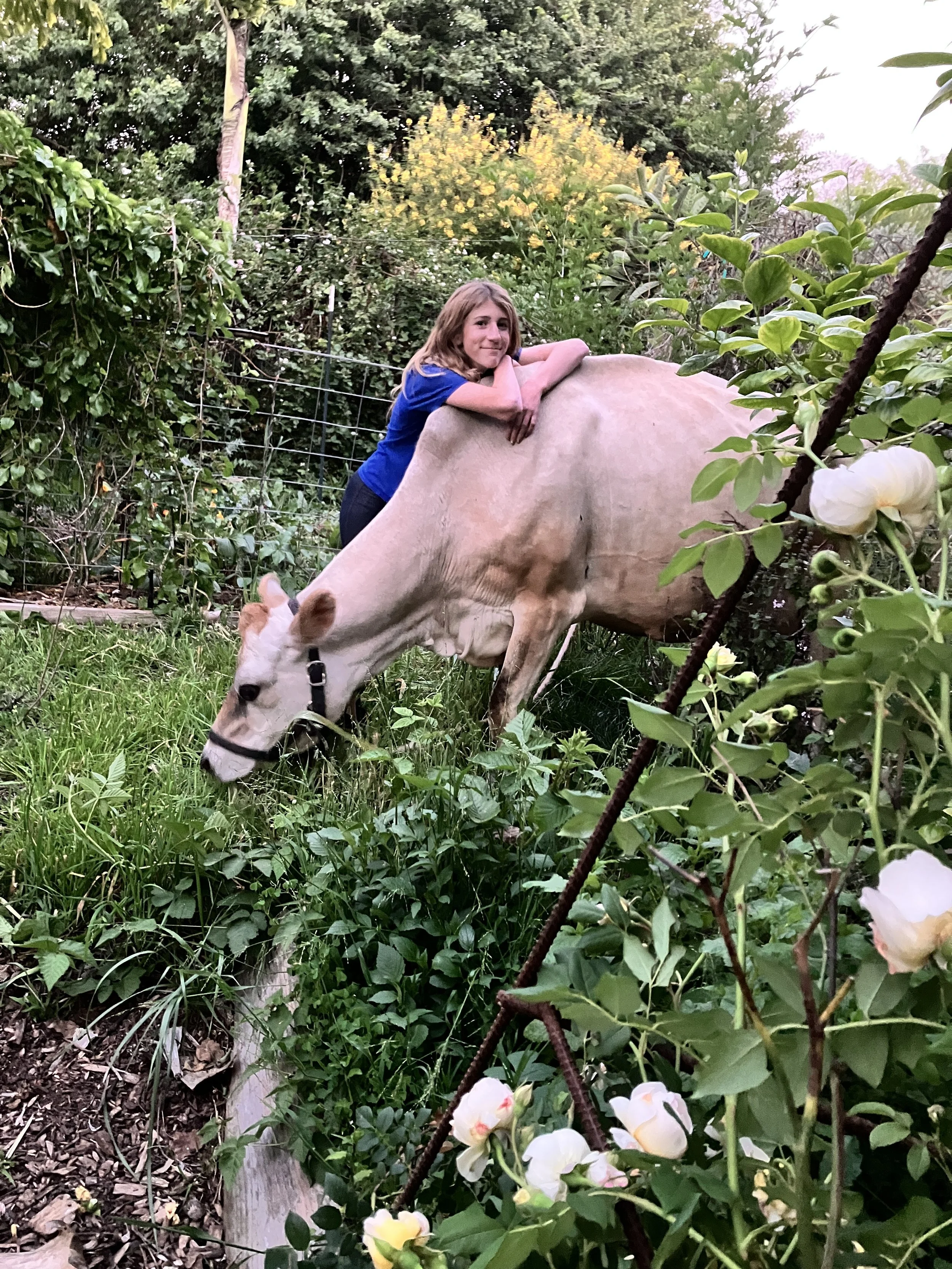
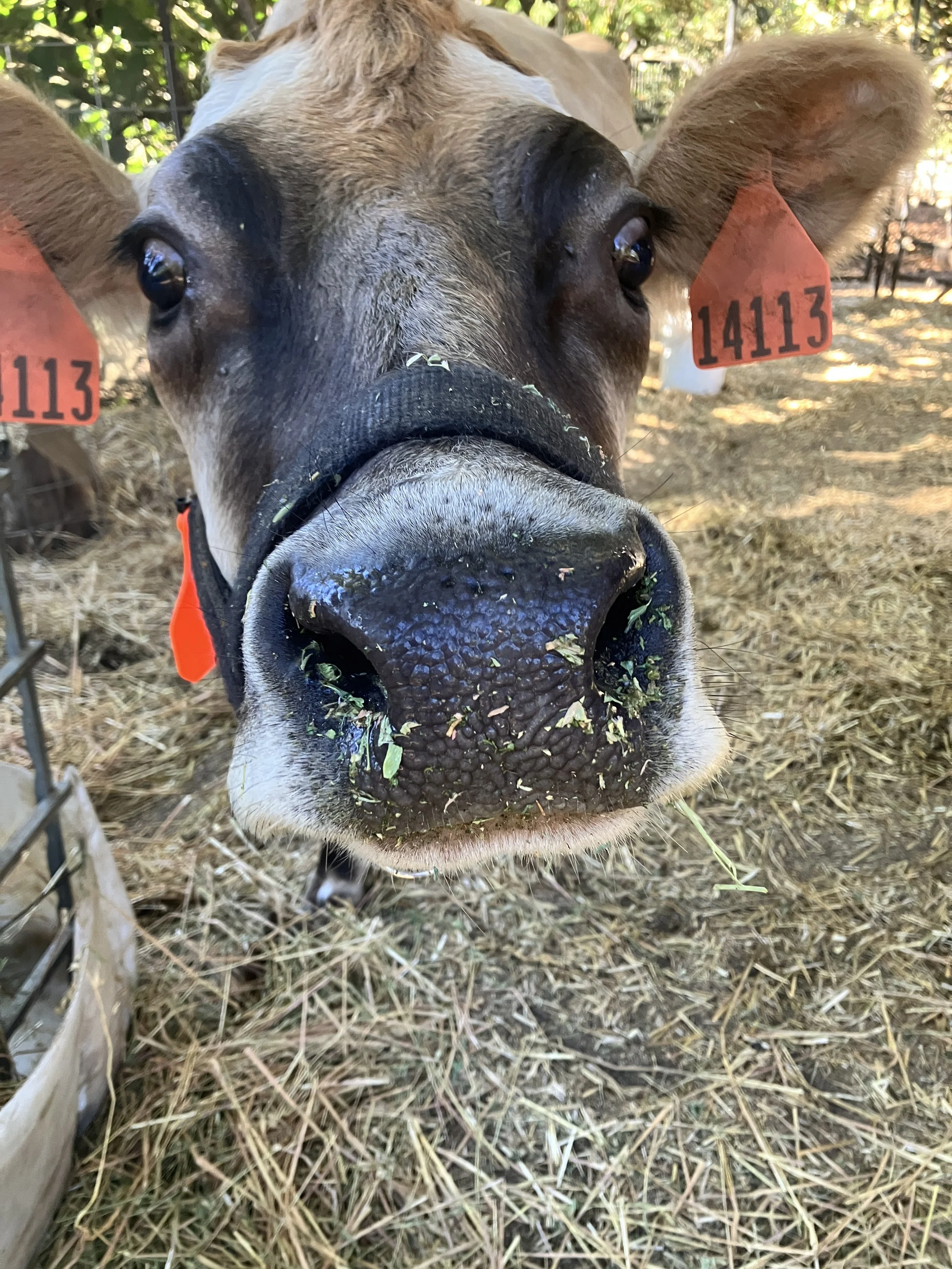
Meet Ursula & Gerti and their dairymaid
URSULA
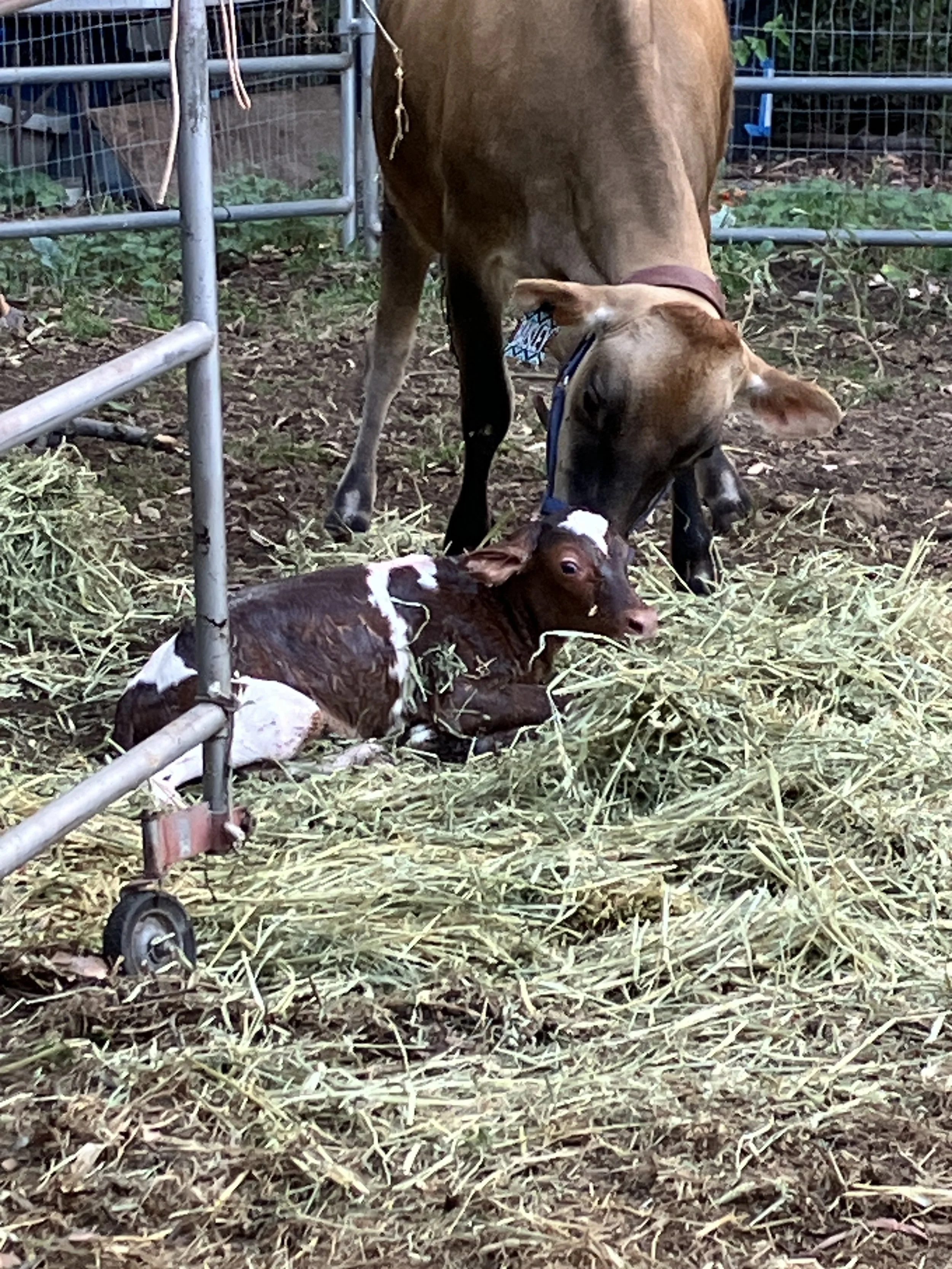
Ursula is a 6 year-old Jersey dairy cow. She has had two calves here: one full Jersey calf and most recently a Jersey x Angus cross.
We selected her for her incredible temperament. She likes people and is mellow and inquisitive. And she is A2/A2.
We suspect she’s originally from the Konyn dairy’s Jersey herd.
Her favorite treats are pomegranates, sliced citrus, grape and banana leaves.
GERTI
Gerti is our second milk cow and she is also an A2/A2 full Jersey. She was born in June 2024 and had her first calf here on our micro-farm on 4/30/26. We purchased her from a farm in Ramona; she’s from the Konyn dairy’s show Jersey stock.
CALF SHARING
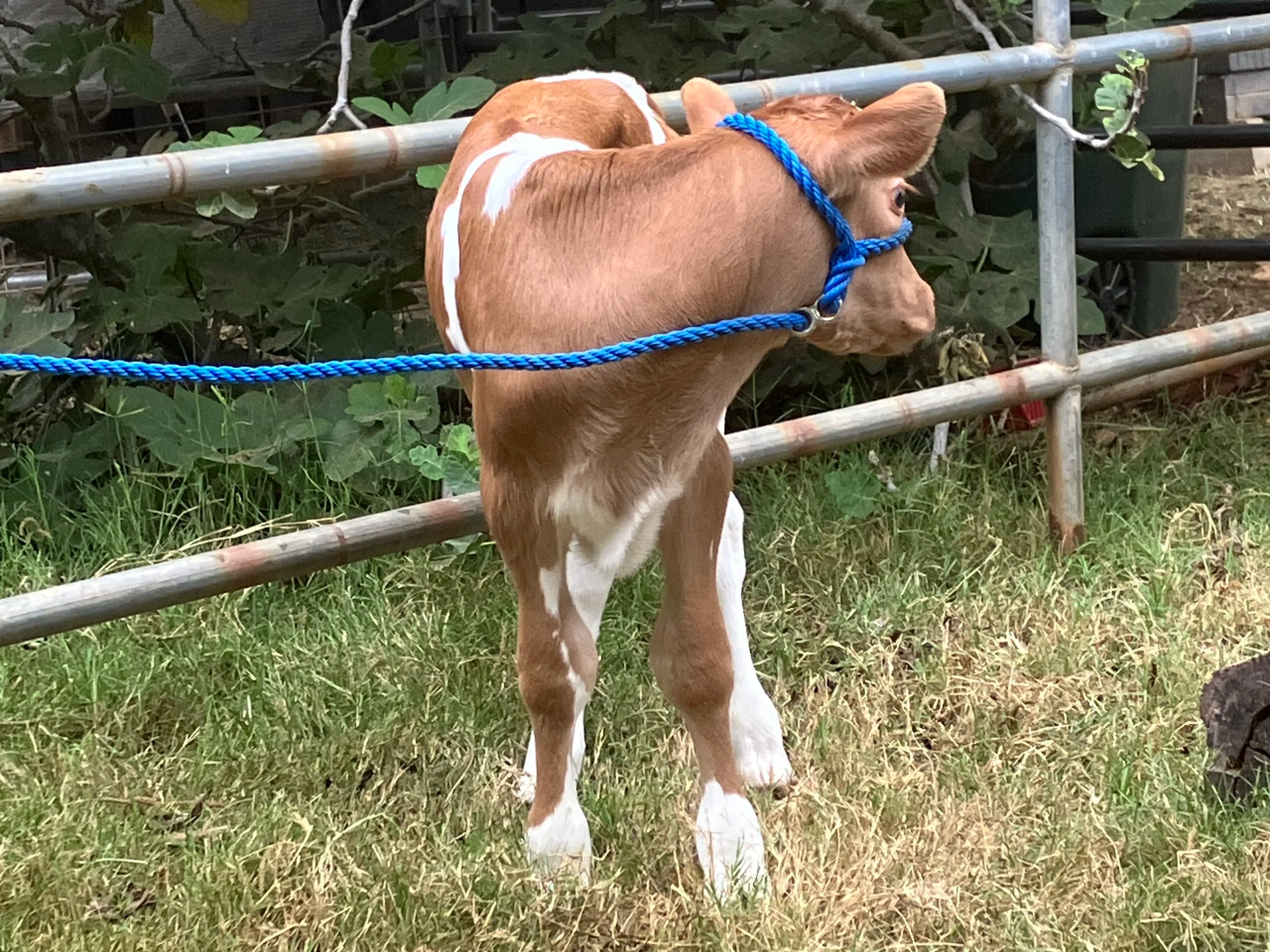
We endeavor to keep calves with her mamas until they are weaned at 6—9 months old. This makes for a happy cow and a well-adjusted calf who learns how to be a bovine from her mom. (This usually isn’t feasible for large dairies. They separate the calf right away so they get all the milk and cream and don’t have to manage calves. AND calves are notoriously hard on dairy teats which have been bred for machine milking not to withstand sharp calf teats.)
Once our calves are about two months old, they get their own night-time sleeping enclosure right next to their mama, so they don’t become overweight or get diarrhea from drinking too much milk. (Dairy cows produce 2-3 times the milk their baby needs but no one told the baby that, so they drink and drink.)
Our practice of keeping baby and mama together during the day means that the humans get less cream at the top of their milk jar, because as long as Ursula knows her baby is nursing, she saves the best— the creamy hind milk- for her baby. That’s a good mama. When she has weaned her calf at six to eight months, we’ll get more of the creamy hind milk in every jar.
We dry our cows off (don’t milk them) for 45-60 days before they give birth. This gives their udder time to replenish itself and so she has a chance to devote all her energy to growing her calf for the last months of gestation.
No milk is available during the 45-60 days when she is dry. This is her body’s rest period to prepare for birth.
GERTI & URSULA’S HUMAN
Our cows are cared for by her 14-year-old dairymaid who milks, mucks, feeds, trains, and hangs out with her cows about two hours every day. Caring for a dairy cow is a big commitment. The dairymaid gets help from her mom too.
-

Clean Milk
Free of antibiotics, artificial hormones. We don’t useantibiotics unless they are medically necessary. We vaccinate against common cattle diseases and of course provide medical care as needed. For example, if our cow had an udder infection that didn’t respond to regular treatment, we would, of course, give her antibiotics to heal properly. Milk would not be provided then.
Raw. Unpasteurized for a natural product. Pasteurization yields a highly processed sterile but dead milk. Raw milk has natural lactase and other enzymes to easy digestion (how nice of the cow to provide that in her milk!), live beneficial bacteria for our gut microbiome. Families are welcome to pasteurize their own milk at home if desired.
OUR MILKING PRACTICES
Clean. We use the best practices for udder cleanliness and health. Her teats are scrupulously cleaned with non-NPE dairy teat dip & dairy wipes prior to machine-milking. We use a stainless-steel milk canister, food-grade silicone inflations and hoses to machine milk ensuring milk enters a closed system. This means no dust floating into an open milking bucket nor human hands touching the teat or milk. The machine is carefully cleaned immediately after every milking using a three-stage rinse, clean, sanitize procedure.
Filtered. We pour milk directly from the milking machine stainless steel canister through two commercial-grade sterile filters into sanitized glass jars.
Glass not plastic. Milk is stored in 1/2 gallon sanitized glass jars.
Rapidly chilled. Milk jars are then placed in a dedicated milk freezer in sa below freezing solution. This ensures much faster cooling. This is critical because the milk comes out of the cow at her body temperature of 100 degrees Fahrenheit and needs to get to below 40 degrees in under two hours.
Whole & not homogenized. The cream naturally floats to the top. Scoop it to make whipped cream, butter, ice cream, add to yogurt, desserts, drinks. What is left is skim milk after you skim the cream. Or just shake the bottle and pour for temporarily distributed cream within the milk for whole milk.
Homogenized commercial milk, in contrast, has been forced through tiny screens at high pressure to break up the fat globules to evenly disperse the fat throughout the milk. Ironically, homogenization plus the ultra-high heat of pasteurization, makes commercial milk a remarkable yet highly processed food.
-
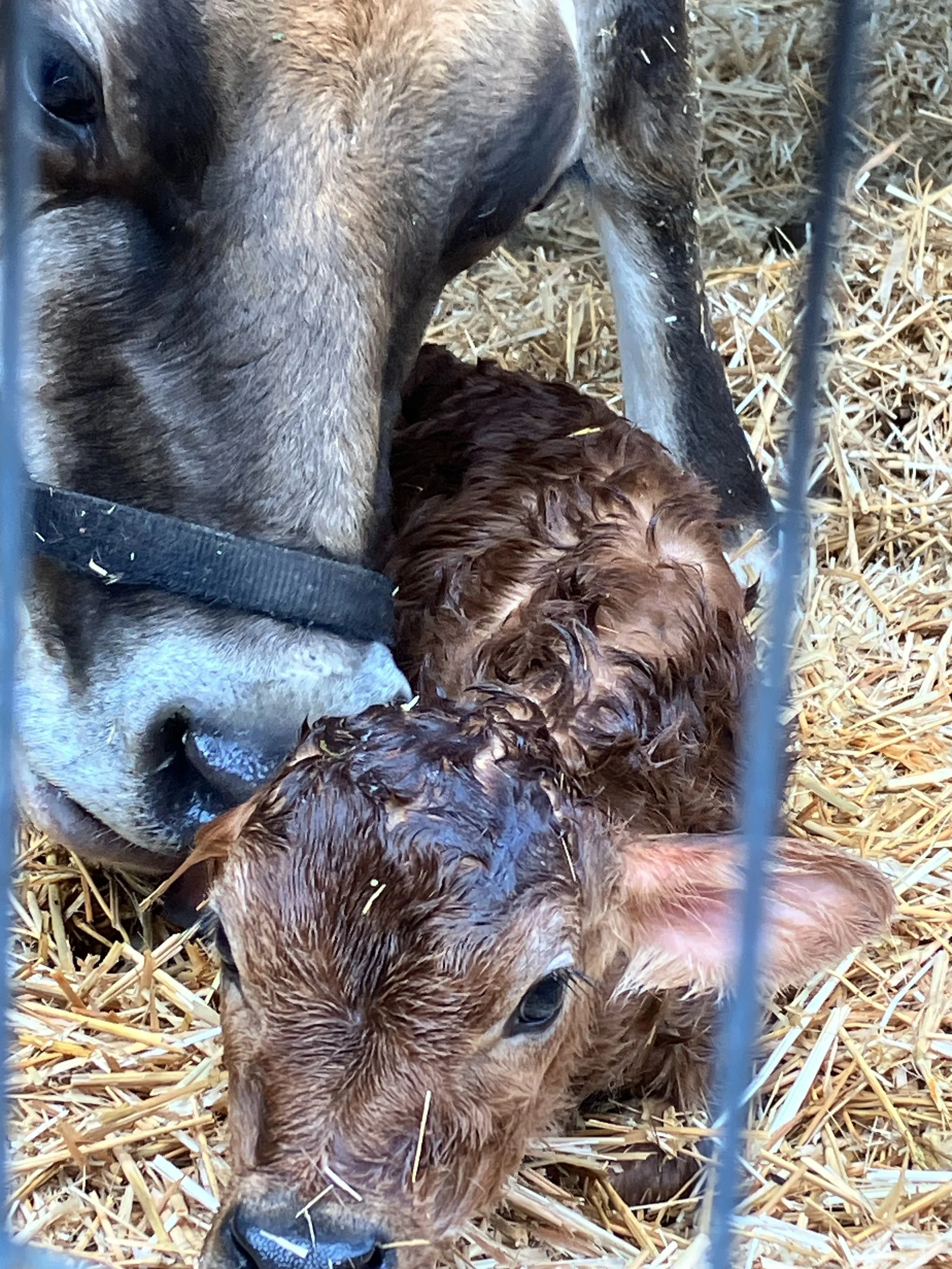
Rich A2/A2 Jersey Milk = More of all the Good Stuff
Chefs love Jersey milk because it has more of all the good stuff than milk from other dairy breeds of cows. Jersey milk, compared to milk from Holsteins (the big black and white cows) has
18% more protein, 20% more calcium, 25% more butterfat.
CREAM!
That thick line at the top of your milk jar is the cream line. The first six - seven months of her lactation, we get about 1.5 inches of cream which is about one and a quarter cups. Cows can control their let down of milk, so Ursula holds back the hind milk, which is creamier than the foremilk, for her baby. Once we wean the calf we get over a pint (2 cups) per half gallon! Some jars have 2 ½ cups of cream on top of the milk! (See photo below with the purple lid to see the post weaning cream line.)
The longer the milk sits in the jar, the more cream separates out. Natural, raw cream is not as viscous as pasteurized cream. The high heat treatment that is pasteurization changes the viscosity, among other things.
Here’s what the percentage of butterfat in cream is after standing or rising for 12, 24, and 36 hours:
12 hours - 18-20% butterfat. Often called cereal or coffee cream. (For comparison purposes, half and half is half cream and half milk and it is 12% butter fat)
24 hours - 32% butterfat. Often called light cream. Cream needs a minimum of 30% to whip well.
36 hours - 40% or more butterfat. Called heavy whipping cream.
To whip your cream, it must be COLD and it must have been chilled to 40 degrees Fahrenheit for at least 24 hours. Chill your mixer bowl, and the beater first and whip the cream straight from the fridge.
You can scoop this cream off the top to make butter, ice cream, pour it in your dirty soda or tea, or whip it to make whipped cream. What’s left after you skim the cream off the top is skim milk. Or shake the bottle up to temporarily distribute the cream throughout the milk for whole milk.
A2/A2 BETA CASEIN PROTEINS
Gerti is A2/A2, by parentage. That means her dam and sire are both A2/A2 so she is as well.
Ursula has been DNA tested by UC Davis Veterinary Genetics Lab. She is A2/A2.
This is what her UC Davis report says: Based on the aminoacid present in position 67 these variants can be classified into 2 groups - A1 and A2. Variants in the A1-group (Histidine) are A1, B, C, F and G. Variants in the A2-group (Proline) are A2, A3, D, E, H1, H2, I, K and L. The levels of bioactive peptide beta-casomorphin 7 (BCM7) produced from the metabolism of beta casein is several-fold higher for variants in the A1 group than in the A2 group. Higher levels of BCM7 have been associated with negative health effects in humans. Relative to levels of BCM7 production, variants within each group behave similarly but may differ in other properties.
To read the latest research summary of the impact of A2 variant vs. A1 variant on human health, visit this link: https://pmc.ncbi.nlm.nih.gov/articles/PMC10806982/table/Tab1/