Hybrid Math 7
Ms. Lisa Clark-Burnell
Math 7
Fall 2026 & Spring 2027 Tuesday 3:00-4:45 pm
THIS COURSE COVERS ALL 7TH GRADE COMMON CORE MATH STANDARDS
At a glance: FALL SEMESTER = Monthly math classes at Farm School with an option for a second math class every other week. SPRING SEMESTER = weekly classes at Farm School
FALL SEMESTER
($225 for seven hours of direct instruction and complete 14-week course)
Once a month students attend class with Ms. Lisa at Farm School to learn the one new concept for that month (the rest is review from grades 4, 5, 6).
The other three weeks, students complete step-by-step at-home math practice provided by Ms. Lisa.
Monthly Math Class: Tuesdays 3:00 to 4:45 pm on 9/1, 10/6, 11/3, 12/1 - Ms. Lisa teaches students how to do the “hard”/new parts of this month’s math work (direct instruction.) We also play games, take notes, and do practice problems.
WHY meet once a month? The first semester of Math 7 is primarily review of math from grades 4-6 to establish a firm foundation for the new material in spring semester. There are about four new concepts in first semester in a traditional math 7 course. So, I teach the new material once a month in class and students refresh their memory the 4th, 5th, and 6th grade review material at home using the homework assignments and support curriculum which I provide. This saves students time and funds so they can spend both on other endeavors.
At-home practice: after our monthly class, students practice their math at home using the assigned homework and support materials. I provide:
Homework checklists students check off as they complete work each week. Includes about 40 problems a week or 10 problems 4 nights a week.
Curated linked video library of multiple videos for each homework checklist
Answers and complete worked out solutions for all assigned problems
Loaned Math 7 Textbook, PDF of additional support materials/worksheets.
Parental role is simply to makes sure students are doing their weekly math practice as outlined by Ms. Lisa. EVERYTHING ELSE IS PROVIDED. This is a COMPLETE fall semester math 7 course.
Option for a second monthly class: Math 7 Support. This is offered on the 3rd Tuesdays, same time. So students who want more direct math instruction can meet every other week.
SPRING SEMESTER
($550 - 14 week class, 24+ hours of direct instruction.)
Weekly classes with Ms. Lisa every Tuesday in spring semester.
Weekly classes for 14-weeks. 1.75 hours of in-person instruction per week
WHY meet weekly? Spring semester is where most of the new math material falls. Thus each week in spring, students come to class for 1.75 hours of direct instruction, games, note-taking, quizzes.
At-home practice: Each week students are assigned homework for the week to practice the new concepts & to review old material.
Is this class right for my student?
-
-
FAST MATH FACTS: Work on fast multiplication of “times tables” 1-10.
Master the pre-requisites concepts from the list above.
How can I master the prerequisites?
Many students find Beast Academy Level 4C, 4D and 5A, 5B over summer or the year before especially helpful. (Their program is cheap $16 a month! or $100 a year.) This hands down THE BEST elementary/early middle school math course currently available.
Other students prefer a traditional or common core 6th grade math course.
-
Students will master all of Common Core Math 7. This is a self-contained class; no additional parental instruction is required.
Detailed course outline is here.
MATH 7 CONCEPTS
Variables & Expressions: use order of operations to simplify variable expressions and combine like terms
Exponent rules: solve 7³ ÷ 7², intro to negative exponents, scientific notation
Factors: Find greatest common factors, least common multiple simplify 21a²/49ab. Explore factoring polynomials with algebra tiles
Fractions review (but students should have a solid grasp of fractions from 4th, 5th and 6th grade math.)
multiply and divide fractions, (it’s also helpful but not critical to be able to clear fractions when solving an equation by multiplying by the reciprocal): -5/48= -5/6+5x/16
add and subtract mixed numbers both like and unlike denominators
Equations: Solve single-variable equations using multiple transformations such as 6x + 2 = 2(3x+1) or (6x +3)/2 = 5x-1.
Introduction to Graphing linear equations, including direct variation as well as relations and functions: what is a function? how to use the vertical line test. What is slope?
Rates, Ratios and Proportions:
write an equivalent rate if a jet flies 540 miles per hour write it’s rate in miles per minute by multiplying by a conversion factor
solve proportions 5/6 = x/18
find the ratio of corresponding side lengths of similar figures, make scale drawings,
Probability & Odds: Theoretical and experimental probability. Use experimental probability to predict probability (If I can make 65% of my free throw shots predict how many shots I’ll make if I take 43 shots over the season?)
Percents
convert fractions to decimals to percents and vice versa
Solve the three basic percent problems: what number is 42% of 93? What percent of 110 is 43? 11 is 22% of what number?
Simple interest problems: Interest = prt, Balance of Account = P + prt. Calculate rate given principal, time and principal.
Geometry:
Perimeter, Area of 2-D and 3-D shapes such as triangles, circles, parallelograms, trapezoids,
Volume of prisms, cylinders, pyramids, cones
Introduction to classifying triangles by angles, side length. Using Pythagorean theorem to solve problems
Introduction to angle relationships: classifying special angle pairs such as vertical angles, complementary & supplementary angles, identify angles formed by a transversal intersection to parallel lines
Polynomials
Add and subtract polynomials: (x² +4x -9) - (4x² - 5x +11)
Multiply monomials and polynomials using the distributive property: 2x(-3x+7)
Data analysis & Statistics: measures of central tendency such as mean, median and mode.
-
CAN MY STUDENT SKIP 6TH GRADE MATH?
SOMETIMES, YES.
This depends on how complete their 5th grade math education was. 6th grade math has A LOT of review of 4-5th grade math, plus new concepts which we tackle AGAIN in the spring semester of Math 7.
Answer these two questions:
#1 Is my student lightening quick at mental math facts including their multiplication facts? (Can they answer 6 × 7 in less than a second? They don’t have to think, they just know it.)
#2 Did my student fully master these 5th grade math concepts listed below? (Because these are all reviewed in 6th Grade Math- especially fractions! If they aren’t solid at fractions, then they will drown in Math 7)
Order of Operations (PEMDAS)
Multi-step word problems
Patterns and graphs
Place value
Decimal operations (add, subtract, multiply and divide decimals by hand - no calculator) and powers of 10.
Fraction operations: addition and subtraction with like and unlike denominators. Multiplying fractions and mixed numbers. Dividing fractions.
Convert measurements (inches to feet etc)
Data: line plots
3-D Geometry: volume of rectangular prisms
Geometry: Graphing points and shapes on a coordinate plane
Geometry: relationships between 4-sided figures & classifying triangles and quadrilaterals
The following are the only new math concepts in 6th grade math (and we do all of these in Math 7 again)
ratios and proportions: ratios & unit rate (price per ounce, miles per gallon), conversion factors - feet to yards etc
percents: converting percents to fractions and vice versa, Percents: what is 70% of 50?
exponents Evaluating expressions with exponents 4² = 4 × 4 = 16
Fractions: dividing mixed numbers, greatest common factor (GCF) and Least Common Multiple )LCM)
substituting values in for variables Evaluate variable expressions r + 4 has what value if r =6?
Positive and negative integers on a number line
one step equations, One-step equations 3 + r = 8, writing an equation from a table
Data displays and measures of central tendency: Mean, median, mode, range, outliers, Box & whisker plots, line plots, histograms
The 6th grade math concepts above we review in Hybrid Math 7 - second semester mostly. Thus, I sometimes have students who are really good at math skip grade 6 and go straight to this math 7 class because everything that is new in 6th grade math, we do again in spring of 7th grade math.
If your child wants to get ahead and rocked 5th grade math, talk to me. You have a couple of options:
Bone up on the new 6th grade math concepts over spring and summer via Beast Academy Level 4C, 4D, 5A, 5B, 5C. ****THIS IS MY RECOMMENDATION****
Do a common core 6th grade math curriculum over spring and summer (IXL or a common core linked workbook)
If your kid is a whiz at math and totally rocked 5th grade common core math, they could conceivably skip the 6th grade material and learn it all for the first time with Ms. Lisa in Hybrid Math 7. But they need to be really, really good at math, always do their homework, and not miss class, otherwise Hybrid Math 7 will feel too fast.
-
Unique features: In this class, students will meet up with Ms. Lisa once a month to learn the new math concept for the month.
Then students need to do four weeks of math homework as outlined by Ms. Lisa at home for that month to practice that new concept and the Math 6 review material that is folded into Math 7. Repeat: Meet with Ms. lisa and student for direct instruction and get the month’s homework. Do the homework. Repeat.
This model’s advantages - saves family’s time and resources since we are mostly reviewing Math 6 first semester and introducing 4 new concepts.
This model’s challenges: requires discipline and probably reminders from a parent to keep a student from procrastinating. Weekly homework needs to be done weekly, NOT crammed in at the end of the month.
-
Sequence of Math Classes at Farm School
Year 1: Hybrid Math 7. This first year, we cover all of integrated math 7 which introduces students to much of traditional pre-algebra topics. After this class student are ready for Honors Pre-Algebra + Math 8 here at Farm School.
Year 2: Math 8 + Honors Pre-Algebra (all one course) We master traditional pre-algebra skills at an advanced level and complete integrated Math 8 as well as introduce a significant number of algebra and geometry concepts. After this second year, students are ready to rock a rigorous Honors Algebra 1 or Integrated Math I. Algebra and Integrated Math 1 teachers report that students who have done Math 8 + Honor Pre-Algebra at Farm School are their best prepared students.
How is this class taught?
-
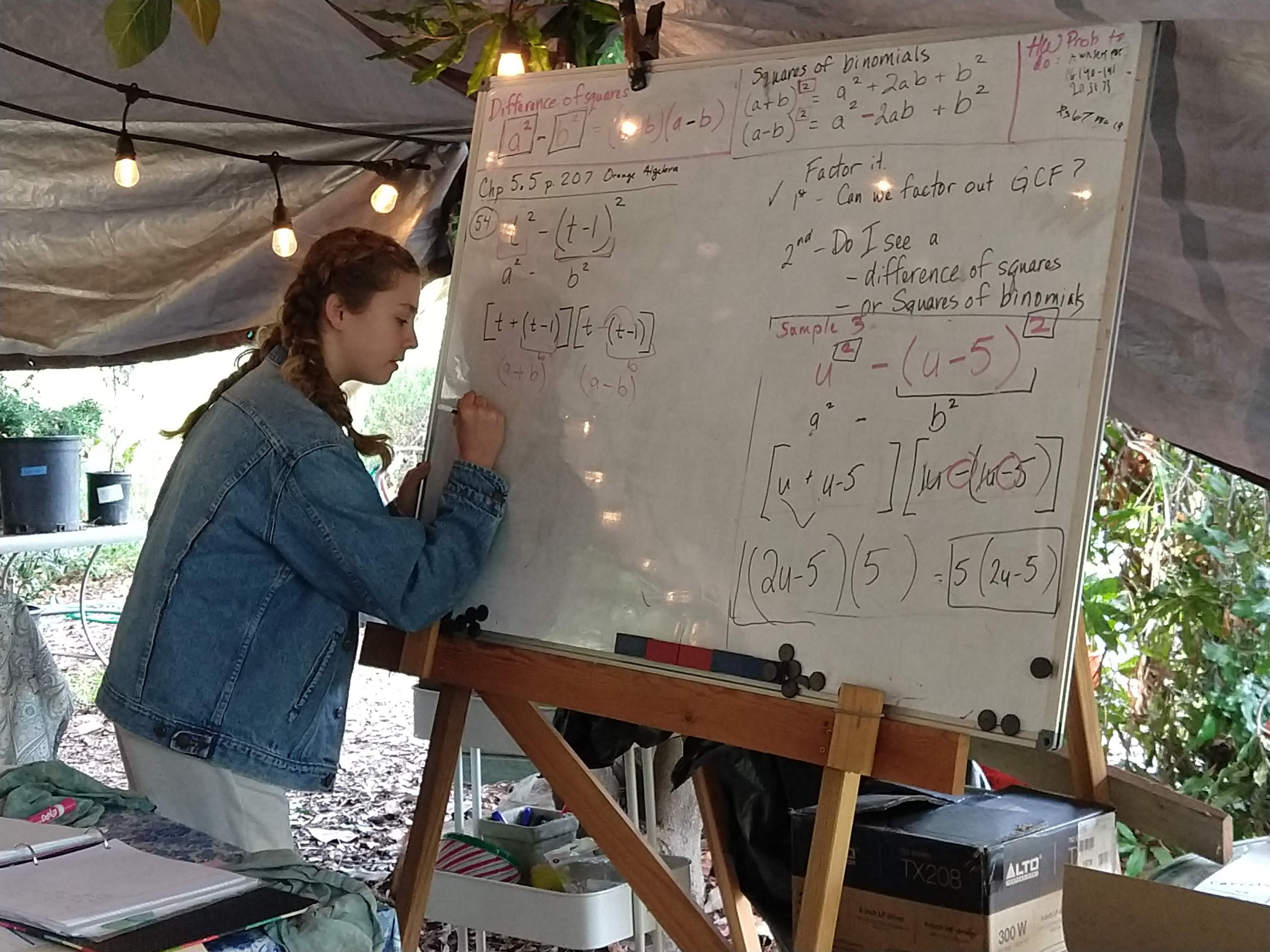
We use Algebra Lab Gear manipulatives to give students a visual and kinesthetic foundation for understanding algebra.
Students build expressions using variable blocks and base-ten blocks.
This hands-on and visual-geometric foundation enables students to make the leap from concrete to abstract thinking which is at the heart of algebra. This facilitates a deeper conceptual understanding rather than simply a rote memorization of algorithms.
The transition to abstract manipulation of terms in expressions and equations becomes intuitive after using Algebra Tiles.
-
Students learn how to
study for tests
take tests well
learn from tests
Tests are one assessment tool which help students, teacher, and parents see what students understand and what they still need to master.
Learning how to show work to get partial credit on a math test and demonstrate one’s logic is a vital skill for any math class through college.
-
Preview via games
Some math concepts need time to sink in, so we explore them via games weeks before we dive into that topic fully. This builds prior knowledge so students are familiar with the vocabulary and concepts.
Review problems and curated video library
Students do review problems with most homework sets to help them remember what they’ve learned to keep skills sharp.
We also play review games to keep our math vocabulary and problem solving skills current.
I have a curated library of online videos for at home reinforcement covering most topics so students may watch demonstrations of how to solve similar problems once they get home if they need more reinforcement or they need to watch a slightly different explanation of how to tackle a problem.
Parents students aren’t stuck sifting through dozens of mediocre or partially relevant videos while looking for a good one! I’ve already found the best videos pertaining to our homework sets to save time.
-
We make time for students to build friendships. Short brain breaks during class and a lunch recess following class during means time for students to chat and socialize. Having math buddies makes learning more fun.
-
Read more HERE
Math 7 Standards, Pacing, Homework, Grading,
This is a self-contained Math 7 class. Parents do not need to supplement their student’s learning. Everything a student needs for Math 7 is taught in this course.
-
One day of class at Farm School is 5 days of math instruction; we move at fast pace second semester. Regularly missing class can put students far behind.
-
Every student does the basic homework problems. Additionally, I offer challenge problems for students who want to try their hand at more difficult problems.
This challenge problems are called SQUARE problems. They are a bit more complicated or nuanced.
Students get one bonus point in the homework category for tackling square work.
-
Homework is a safe place to make mistakes. Making mistakes AND LEARNING FROM THEM is how we grow.
Therefore, Math 7 students get grades on individual HW assignments based upon completion, showing work, correcting errors, not on whether or not they got the problem right.
In fact, students SELF-ASSESS their HW with the instructor checking their self-assessment.
I give students the answers to problems-- they show their work and self-correct including re-attempting problems they missed.
I provide full worked out-step by step solutions for every single problem in the textbook. Students can use these to figure out where their errors are.
I provide a curated library of multiple videos for every section of every chapter so they can watch a different explanation of how to do each type of problem if they missed it.
We have some time (but not a lot) for problems they still can’t figure out to be done in class AFTER they’ve looked at all the steps and watched a support video.
Students who want more support in fall can sign up for an Extra Math Support class.
Reinforcing excellent learning habits: Students earn excellent learning habits tickets for homework turned in on time, for keeping an organized notebook for use on tests and other excellent learning habits.

-
Detailed course outline is here.
THIS COURSE COVERS ALL 7TH GRADE COMMON CORE MATH STANDARDS
Variables & Expressions: use order of operations to simplify variable expressions and combine like terms
Exponent rules: solve 7³ ÷ 7², intro to negative exponents, scientific notation
Factors: Find greatest common factors, least common multiple simplify 21a²/49ab. Explore factoring polynomials with algebra tiles
Fractions review (but students should have a solid grasp of fractions from 4th, 5th and 6th grade math.)
multiply and divide fractions, (it’s also helpful but not critical to be able to clear fractions when solving an equation by multiplying by the reciprocal): -5/48= -5/6+5x/16
add and subtract mixed numbers both like and unlike denominators
Equations: Solve single-variable equations using multiple transformations such as 6x + 2 = 2(3x+1) or (6x +3)/2 = 5x-1.
Introduction to Graphing linear equations, including direct variation as well as relations and functions: what is a function? how to use the vertical line test. What is slope?
Rates, Ratios and Proportions:
write an equivalent rate if a jet flies 540 miles per hour write it’s rate in miles per minute by multiplying by a conversion factor
solve proportions 5/6 = x/18
find the ratio of corresponding side lengths of similar figures, make scale drawings,
Probability & Odds: Theoretical and experimental probability. Use experimental probability to predict probability (If I can make 65% of my free throw shots predict how many shots I’ll make if I take 43 shots over the season?)
Percents
convert fractions to decimals to percents and vice versa
Solve the three basic percent problems: what number is 42% of 93? What percent of 110 is 43? 11 is 22% of what number?
Simple interest problems: Interest = prt, Balance of Account = P + prt. Calculate rate given principal, time and principal.
Geometry:
Perimeter, Area of 2-D and 3-D shapes such as triangles, circles, parallelograms, trapezoids,
Volume of prisms, cylinders, pyramids, cones
Introduction to classifying triangles by angles, side length. Using Pythagorean theorem to solve problems
Introduction to angle relationships: classifying special angle pairs such as vertical angles, complementary & supplementary angles, identify angles formed by a transversal intersection to parallel lines
Polynomials
Add and subtract polynomials: (x² +4x -9) - (4x² - 5x +11)
Multiply monomials and polynomials using the distributive property: 2x(-3x+7)
Data analysis & Statistics: measures of central tendency such as mean, median and mode,
SUPPLIES
I loan students a textbook. I have in class sets of Algebra Tiles for us to work with. Students print out two pdfs for notetaking and worksheets at home. The rest is standard math supplies. Details below.
TEXTBOOK & Algebra Lab Gear are PROVIDED
I loan a Math 7 textbook to students: Holt McDougal Mathematics Grade 7— However, if you know your kiddo is really hard on textbooks, you may want to buy your own copy for $15-20; readily available online.
Personal supplies students should bring to class
#1
Print this out and store it in a 3 ring binder: K.I.N. Know-it-Notebook for in-class notetaking. See PDF below.
This notebook makes in-class notetaking considerably faster, especially for younger students, and often more legible and thus useful as a study tool.
This 2011 consumable notebook is now out of print so I have a PDF of it available: pages 1-60 and 60 to 120, 120 to end.
(If you can find a copy of it this is what you’re looking for: Grade 7 Know-it-Notebook (We used to be able to find it for $20 Purchase HERE) ISBN 0547687850 or 13 digit ISBN ISBN 978-0-547-68785-8 )


#2
Print this out: H.W.P.W. Homework & Practice Workbook for classwork review (a.k.a. “Bluey”)
This notebook helps students review concepts through the year.
This 2011 consumable notebook is now out of print so I have a PDF of it available below in sections. You can print it out all at the beginning of the semester (we occasionally do pages out of order). Or wait to see what pages I assign each week.
(If you can find a new copy of it from used sellers, this is what you’re looking for: Holt McDougal Grade 7 Mathematics Homework and Practice Workbook Purchase HERE -sometimes available for $8) What students don’t finish in class will be homework.


The rest of this list is traditional math supplies.
#3 Two binders with at least one pocket and THREE tabs/dividers
Binder #1 is for K.I.N. Know-it-Notebook for in-class notetaking & H.W.P.W. Homework & Practice Workbook “Bluey”
Binder #2 is for Homework (HW), Classwork/handouts, Tests, Paper
Pocket is for HW to be turned
Divider for OLD HW & Handouts
Divider for OLD Quizzes/Tests
Paper (lined and graph)
#4 Small spiral notebook for notes - both in-class notes and video notes
#5 Lined paper (wide ruled is best) & graph paper for doing HW
#6 Calculator Casio fx-300ESPLS2 or TI-30xIIS are good models for under $15.
#7. 4×6 Index cards (500 of them) & something to store them in (a zip lock bag and a few rubber bands is fine.) we will record our IMPS (Important Math Principles such as formulas and definitions here so students can quiz themselves every week and we will use them to play in-class review games.)
#8 Good pencils & erasers, plus colored pencils or pens for annotation and correcting work, (sticky notes are handy but not required)
Optional:
Protractor (transparent), drawing compass, & ruler Buy a protractor. Don’t rent a set from a charter school as those rented ones are worthless. A good protractor is a transparent semi circle and has a swing arm. They are about 5$ and students will use it through geometry.
Optional Recommended App - Kahoot Algebra by DragonBox (previously named DragonBox 5) or Kahoot Algebra 2 (previously DragonBox 12 -possibly with some actual algebra 2 content.)