Shakespeare & Co.
A Midsummer Night’s Dream
Tuesdays 12:00 to 3:30 on May 5, 12, 19, 26
Bring a lunch. We start with lunch recess since some students will have just finished their math class at 12:00
$330 per 4-week 3.5 hour class w/lunch recess - payment due 4/21
Preparation: Read at least the novelized (right side) of Act 1 & Act 2 before class starts
Bring No Fear Shakespeare edition of AMND to class, binder with paper/notebook, markers for making props and posters.
May 26, 2026 - Week 4 of 4
Classwork Summary
Presenting “Here and Now” posters of enduring themes
Presenting comparisons of different versions of AMND: what different choices did the actors/directors make in subtext? staging? costumes? lighting? setting? Which version did you enjoy most and why?
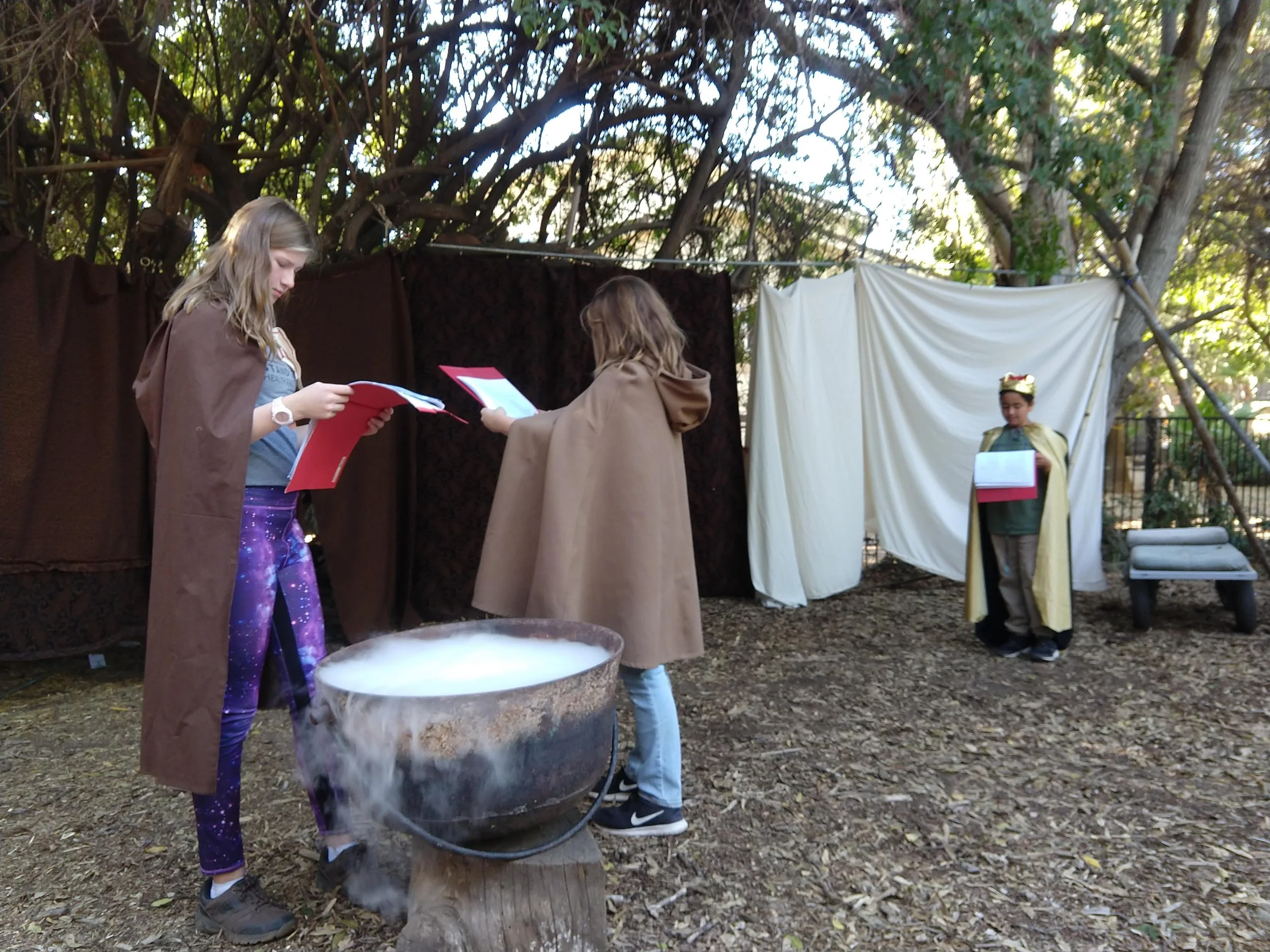
Acting Companies — rehearsing scenes and performing with different SUBTEXT and character? Partners and trios present a few lines in a scene with two different subtexts or characterization.
Whole Class Acting Company — rehearsing Act V and performing.
TABLE OF CONTENTS
Act 1 Scene 2 Script (Bottom and Peter Quince)
Court Map: Who is Who and who loves whom?
Journal Prompt: Relationship problems (friend, parent-child, romantic)
Close Reading chart for Act 1 & 2
Act 1 & Act 2 Puppet/Readers Theater or Regular play
Two keys for unlocking Shakespeare: pronouns/verb endings & using context clues
Pronoun and verb handout,
Context clues handout
Note: here’s an online version of the play if you ever need cut and paste excerpts
May 19, 2026 - Week 3 of 4
Homework
You have two choices for the first part of your homework: compare two versions of the play or make a then and now poster.
Option A) - Compare two different film versions of ACT 1, or the scene in which Bottom is transformed, or ACT 5 of A Midsummer Night’s Dream. How are they similar? How are they different? Think about staging, setting, costumes, lighting, delivery of lines, subtext. Which do you like best? Here are some film versions of the play to consider— there are many more than these out there, many of which you can rent online. Note, not all are kid friendly nor am I endorsing the content of all of these linked below.
“Girls Night In” modern version Act 1 is interesting, Act 5 Starts 1 hour 20 minutes
1935 Film with Mickey Rooney and James Cagney - Bottom transformed scene only
Modern BBC version - Bottom transformed scene only
1999 Kevin Kline and Calista Flockhart (this one needs to be rented and is PG -13)
Option B) THEN AND NOW POSTER Why do we still perform plays that are over 400 years old? Because the emotions of the people and the themes in them still speak to use, are still relevant to our lives in 2026. Choose an important line or series of lines which reveal an ENDURING theme. Create a THEN & NOW POSTER - divide the poster into two equal parts to illustrate the same theme across two different time periods.
Draw the scene from Shakespeare’s text (THEN) and include the actual line (key quotation) and the line reference (example: Act 2. 3. 45-46).
Now draw a modern scene from TODAY which demonstrates this same enduring truth. Write a line in your own modern 21st century English words which states this same enduring theme.
Prepare for Performance Act 5 — the abridged version is here
Rehearse your lines in the mirror every day. What emotion is your character feeling? Are you conveying that? What will you do with your body, face?
Memorize 5 to 10 lines.
Create costume, props, nametag
Costume — are you part of the fairy court? Are you a ruler? Are you human? Are you a worker?
Props— what will you carry? do you need a flower? mirror? wand? scepter? crown? lion mask? bricks on your shirt? flash light and a dog for the moon?
Nametag - needs name in HUGE dark letters, a symbol that reflects your character’s personality
Classwork Summary
Two keys for interpreting Shakespeare: 1) using context clues and 2) understanding pronoun use in Elizabethan English (this is early modern English). As well as verb endings and older verbs we don’t use any longer.
What is SUBTEXT? Activities reading the same phrases with 3 different subtexts.
Actor Companies — rehearsing scenes and performing. Then choosing NEW scenes and breaking into companies to analyze and rehearse a scene for our last week.
Plot Overview of Act 4 & 5 - What are some key lines and topics and themes we see in this act? How is this relevant today?
Sharing HW and close reading — analyzing key lines - why are they thematically important? What do they reveal about the characters or conflict? Literary devices? We are learning to ask ourselves: why are these funny and/or thematically important lines? Or what literary devices are employed here?
TABLE OF CONTENTS
Act 1 Scene 2 Script (Bottom and Peter Quince)
Court Map: Who is Who and who loves whom?
Journal Prompt: Relationship problems (friend, parent-child, romantic)
Close Reading chart for Act 1 & 2
Act 1 & Act 2 Puppet/Readers Theater or Regular play
Two keys for unlocking Shakespeare: pronouns/verb endings & using context clues
Pronoun and verb handout,
Context clues handout
Note: here’s an online version of the play if you ever need cut and paste excerpts
A Midsummer Night’s Dream
Shakespeare’s most performed play in our day.
A study in comedic confusion, instant infatuation, and wonderful wordplay, this comedy is more than just slap-stick and mistaken loves. AMND explores parent-child relationships, friendships, and romantic relationships. What can go wrong in these and how do we repair fractured relationships?
Before class starts:
Read the modern novelized version of AMND Act 1 and Act 2 (which is on the right side of the page of our text).
Students who are comfortable with the original text are also welcome to read any portion of that too; the original text is on the left. Thus everyone will be familiar with the plot and characters from Act 1 and 2 which enables us to dive right into the original text on Day 1.
Overview:
We are reading all of A Midsummer Night’s Dream. Our first two days will be literary analysis, group projects/learning games and our last two days will be a combination of literary analysis, projects, AND reader's theater performances of select scenes. If your student has to miss the last day since our class is starting a week later, let me know and we won't cast them in a scene for the last day. They can prepare props or scenery or work on other presentations.
I don't expect students to be fluent at reading Shakespeare by the end of this seminar. But they will start adding tools to their tool kit which will enable to them to read, understand, and interpret Shakespeare.
May 12, 2026 - Week 2 of 4
Homework
Go back to Acts 3 & 4 and read the original text of at least 10 passages from the “CLOSE READING” Chart handout or other passages which you thought were really important or funny from your first reading of Act3-4 (when you read the novelized version before the start of this class.) Dig into Shakespeare’s language. Use the novelized version to help you understand those passages. Write the KEY lines and why they matter on our Key Lines, Topics, Themes handout. (Our edition is No Fear Shakespeare Edition of A Midsummer Night’s Dream
Note: here’s an online version of the play if you ever need cut and paste excerpts
Prepare for Performance Act 1 & Act 2 scenes:
Rehearse your lines in the mirror every day. What emotion is your character feeling? Are you conveying that? What will you do with your body, face?
Memorize 5 to 10 lines.
Create costume, props, nametag
Costume — are you part of the fairy court? Are you a ruler? Are you human? Are you a worker?
Props— what will you carry? do you need a flower? mirror? wand? scepter? crown?
Nametag - needs name in HUGE dark letters, a symbol that reflects your character’s personality
Classwork Summary
Actor Companies — choosing scenes and breaking into companies to analyze and rehearse a scene for next week.
Plot Overview of Act 3 - What are some key lines and topics and themes we see in this act? How is this relevant today?
Sharing comic strips and close reading — analyzing key lines - why are they thematically important? What do they reveal about the characters or conflict? Literary devices? We are learning to ask ourselves: why are these funny and/or thematically important lines? Or what literary devices are employed here?
LAST WEEK
With pomp, with triumph and with revelling.
This man hath bewitch'd the bosom of my child;
Thou, thou, Lysander, thou hast given her rhymesWith cunning hast thou filch'd my daughter's heart,
Turn'd her obedience, which is due to me,
To stubborn harshness
TABLE OF CONTENTS
Act 1 Scene 2 Script (Bottom and Peter Quince)
Court Map: Who is Who and who loves whom?
Journal Prompt: Relationship problems (friend, parent-child, romantic)
Close Reading chart for Act 1 & 2
Act 1 & Act 2 Puppet/Readers Theater or Regular play
May 5, 2026 - Week 1 of 4
Homework
Finish reading the novelized version of the entire play. Our edition is No Fear Shakespeare Edition of A Midsummer Night’s Dream
Go back to Acts 1 & 2 and read the original text of at least 10 passages from the “CLOSE READING” Chart handout or other passages which you thought were really important or funny from your first reading of Act 1 & 2 (when you read the novelized version before the start of this class.) Dig into Shakespeare’s language. Use the novelized version to help you understand those passages.
Create a comic strip: Select ONE passage (could be an entire scene or several key lines from a scene) and make a comic strip of it. We will share these using the document camera next week. Criteria:
What is this scene about? Show that you understand what is going on and include summaries that help the reader understand what is happening.
Include original text in it. If you use narration that isn’t Shakespeare’s words, come up with a way to distinguish between Shakespeare’s writing and your summary
Illustrations need to contribute to the meaning too.
Use color
Be prepared to explain WHY you chose this scene/these lines to illustrate. Is it because this scene is funny? Important to the topics the play is dealing with? Relevant to our lives today?
Note: here’s an online version of the play if you ever need cut and paste excerpts
Classwork Summary
Getting to know each other: we are a mix of students from all of my classes. Talked about what our experience on a stage (including sports) is and how comfortable we are with a speaking role in a performance or if we prefer puppet show parts. (This varies from student to student.)
Actor’s Circle: three acting companies rehearsed and read for us the scene in which Peter Quince and Nick Bottom and the other “rude mechanicals” decide who gets which parts in Pyramus and Thisbe.
We LISTENED (did not read along) as each company performed the same scene. This repetition helps us uncover new things each time we hear it. We modelled how to read closely, how to read the same passage multiple times, how to ask questions about possible ways to think about the relationships between characters. We focused on how a play is meant to be heard and seen, not just read.
We asked questions about possible settings, character relationships, motivation and traits. We used lines from the text to support our interpretations. This scene served as our way into the play. We modelled how to read closely, how to read the same passage multiple times, how to ask questions about possible ways to think about the relationships between characters.
Getting Organized - setting up a table of contents (see right)
Contemporary themes in old writing: This play is over 400 years old but is still performed hundreds of times a year around the globe! Why? Journal prompts about relationship problems: friendships, parent-child relationships, romantic relationships.
Plot Overview of Act 1 & Act 2 - comic strip introduction (and a model of how to make a comic strip which uses both summary and original text)
Close Reading Practice Act 1 Scene 1 - paying careful attention to word choice and meaning in key passages from Act 1 Scene 1. We looked at LITERARY DEVICES such as parallel structure (in the first set of lines), alliteration (second set of lines) and the humor as well as important issues and conflicts raised immediately. We are learning to ask ourselves: why are these funny and/or thematically important lines? Or what literary devices are employed here?
With pomp, with triumph and with revelling.
This man hath bewitch'd the bosom of my child;
Thou, thou, Lysander, thou hast given her rhymesWith cunning hast thou filch'd my daughter's heart,
Turn'd her obedience, which is due to me,
To stubborn harshness
TABLE OF CONTENTS
Act 1 Scene 2 Script (Bottom and Peter Quince)
Court Map: Who is Who and who loves whom?
Journal Prompt: Relationship problems (friend, parent-child, romantic)
Close Reading chart for Act 1 & 2