In Real Life Farm Science
Hands-on zoology & botany for middle schoolers
How do plants defy gravity and draw water UP through their xylem from roots to leaves? What ecological role does the cattail at the pond’s edge play? Why does the cow chew her cud? How does the earth worm create humus? How long will the calf nurse? Why do pigs eat almost anything? How can rabbits digest the cellulose in grass? What makes a bull aggressive? How do pigs cool off? Why do koi fish eat less in cold weather?
How do plants defy gravity and draw water UP through their xylem from roots to leaves? What ecological role does the cattail at the pond’s edge play? Why does the cow chew her cud? How does the earth worm create humus? How long will the calf nurse? Why do pigs eat almost anything? How can rabbits digest the cellulose in grass? What makes a bull aggressive? How do pigs cool off? Why do koi fish eat less in cold weather?
The fascinating life science of the farm
We examine zoology and botany through the lens of the animals and living creatures who call the ecosystem at Farm School on Mt. Helix home.
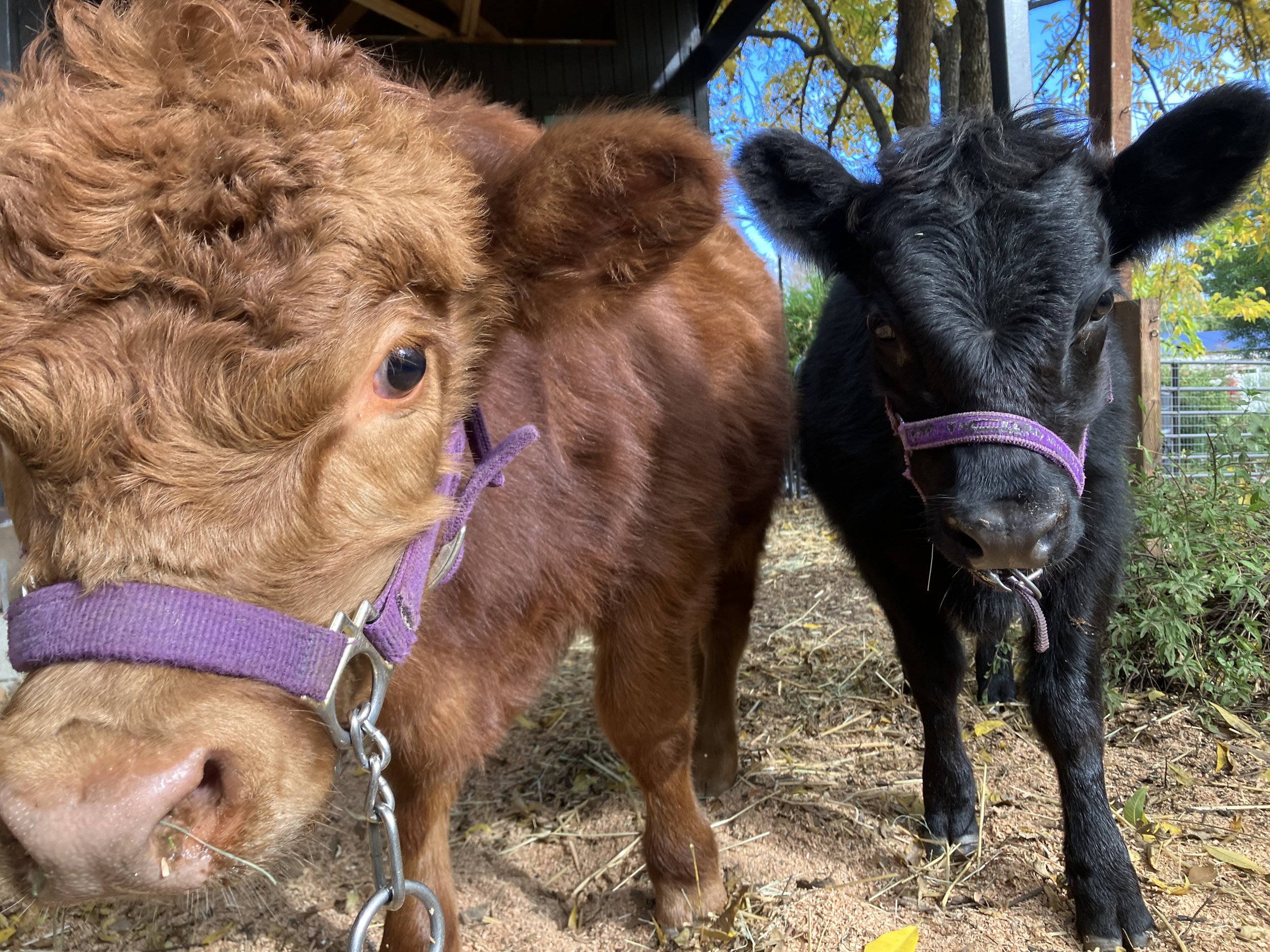
Zoology becomes real when understanding how the pH of our Dexter miniature cow’s, rumen is affected by what she eats which shapes which microbes thrive in her belly which impacts how efficiently she can digest hay vs grains and thus what we feed her.
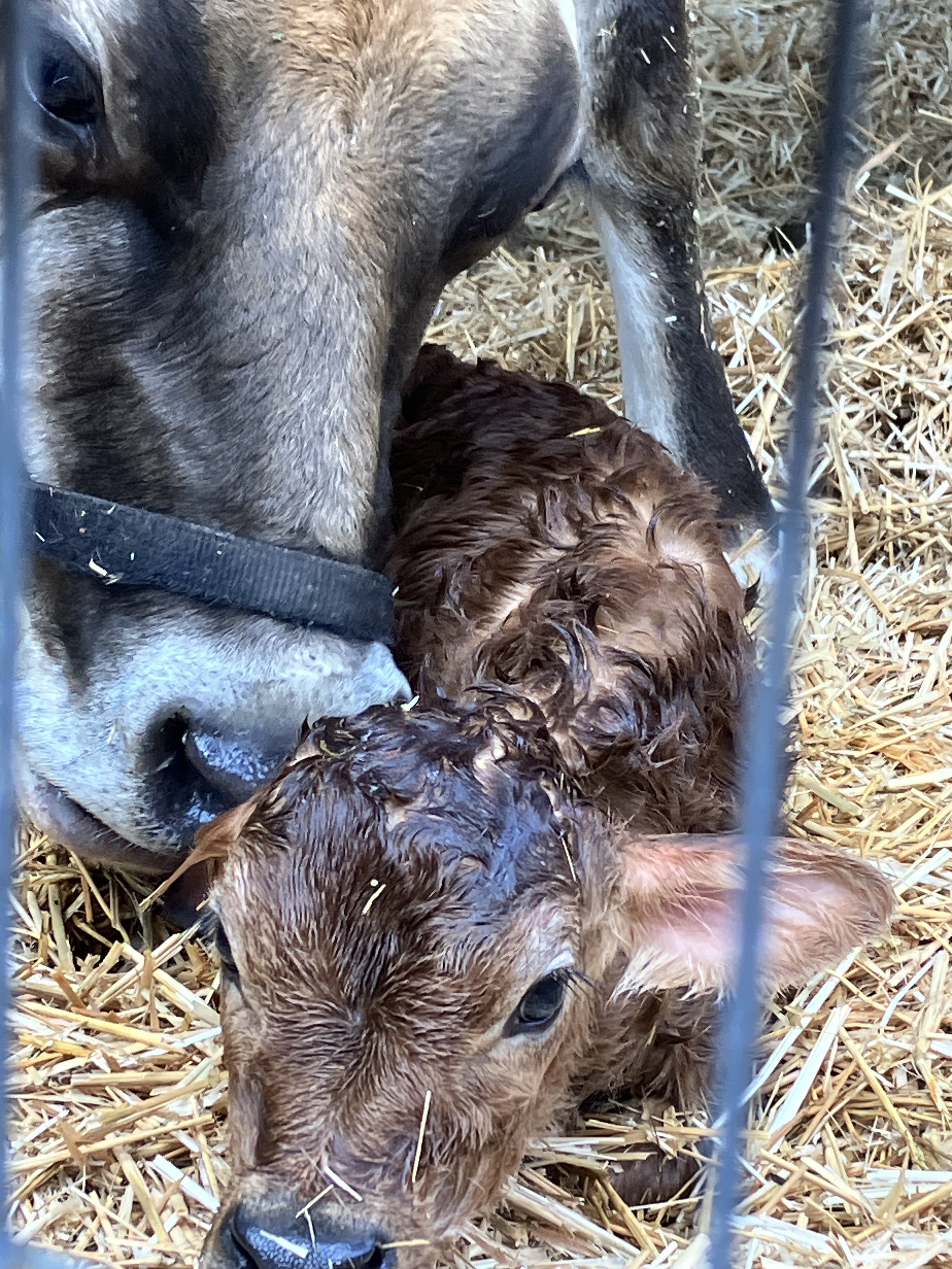
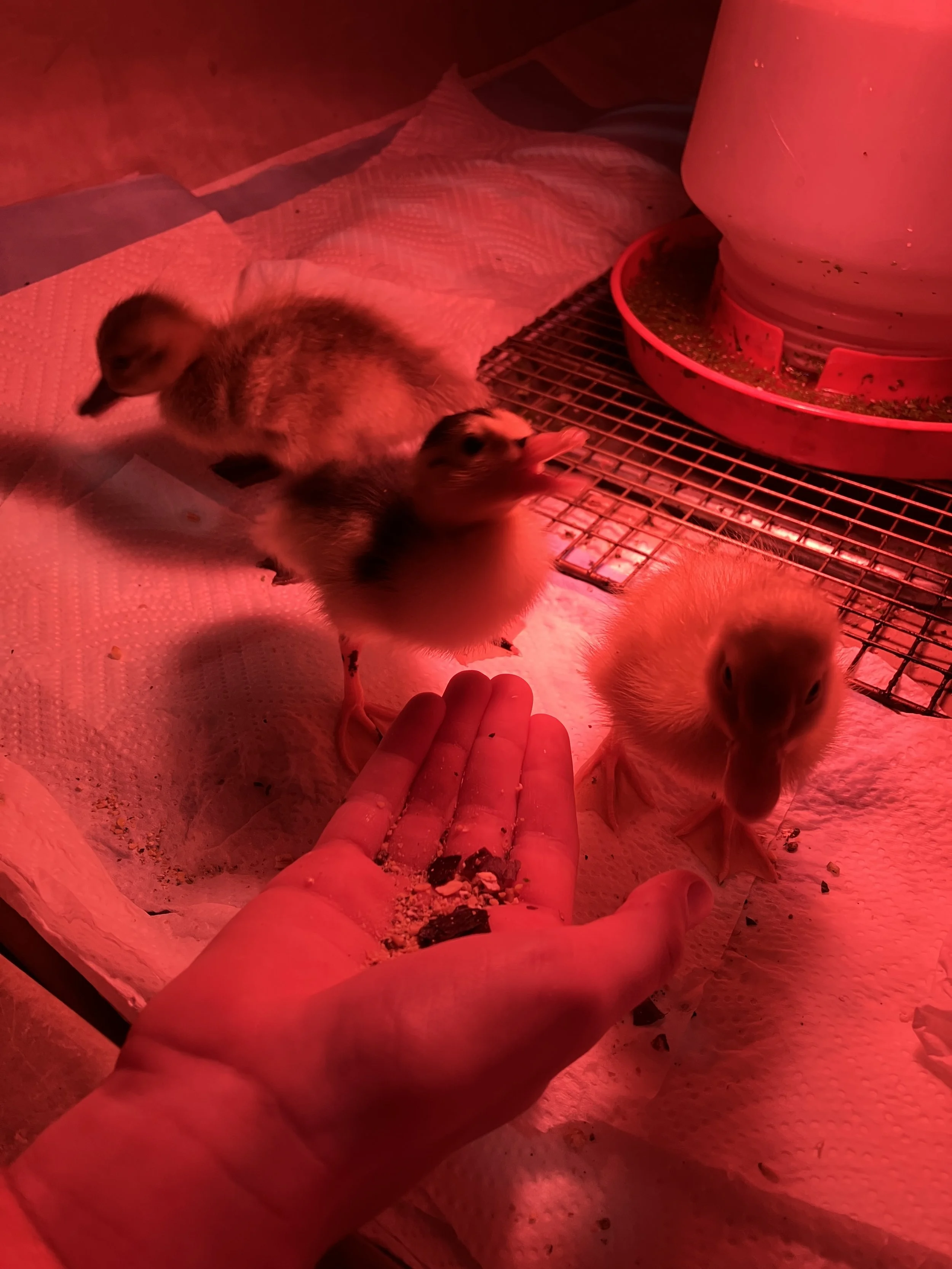
The specific organisms we study each semester depends upon what is happening on the farm and what students are curious about! If we have baby calves, bunnies, ducks, fish, pigs - we learn about those. If students are into the wild creatures that call Farm School home, we’ll dive into those. Any given year we may study ruminants, lagamorphs, canines, felines, mustelids, poultry, waterfowl, freshwater game and hobby fish & snails, sundry insects, earthworms and more.
Students may take this class two to three years in a row as each year we cover new material in a three-year cycle.
Zoology and Botany on the Farm
-
Soil science: pH, humus, Pig anatomy in comparison to human anatomy,
How to plant a tree,
Growing a veggie garden,
How to plant succulents
Bovine birth and delivery
Introductory genetics
Warm-blooded (endothermic) vertebrates
Birds -characteristics, behavior, and classification
Waterfowl anatomy, physiology, and care
Poultry and local raptors
Pond visitors: herons and cranes
Mammals- classification into 21 orders (differences in reproduction, jaw structures and teeth, locomotion)
Reproduction: placental mammals or marsupial: Opossum -marsupial
Ungulates (hoofed mammals)
Odd toed: Horses, donkeys, zebra, tapir, rhinos
Even toed:
single stomach: pigs & peccaries
three chambered cud chewers: camelids (alpacas, camels, llamas)
true ruminants: bovidae (cattle, bison, water buffalo, African buffalo, antelopes, sheep, goats) & others (deer, giraffe, pronghorn)
Rodent-like mammals (including Lagamorphs -rabbits and pikas) anatomy, physiology, and care and DNA & heredity
Rodents (rats, kangaroo rats etc)
Carnivores:
canines (dogs, wolves, coyotes, foxes),
Felines (cats, bobcats)
raccoons,
mustelids (skunks, weasels, badgers, otters, wolverines)
Cold -blooded (exothermic) Vertebrates: Fish, amphibians, reptiles,
Fresh water fish: catfish, koi, blue gill, guppies, mosquito eaters,
Amphibians - local
Reptiles -local
Invertebrates – including insect orders
Pond microscopic organisms
Raising turkeys or other poultry from chicks
Raising catfish
Breeding and raising baby bunnies


Farm Work = Social time + Animal Husbandry
Students learn the science behind how to care for the living things at Farm School. This farm work time is students’ favorite in part because they work in teams.
Above two students groom Mango, a miniature heifer. She’s wearing her fly mask as it is late summer. Students learn how to put her fly mask on, how flies use the teeth-like structures on the tip of their tongues to scratch cattle and horse’s eyes to then feast on the protein rich secretions from animal’s weeping eye. We then study fly life cycles, different methods farmers use for fly management and the pros and cons of varying approaches depending upon the farmer’s goals.
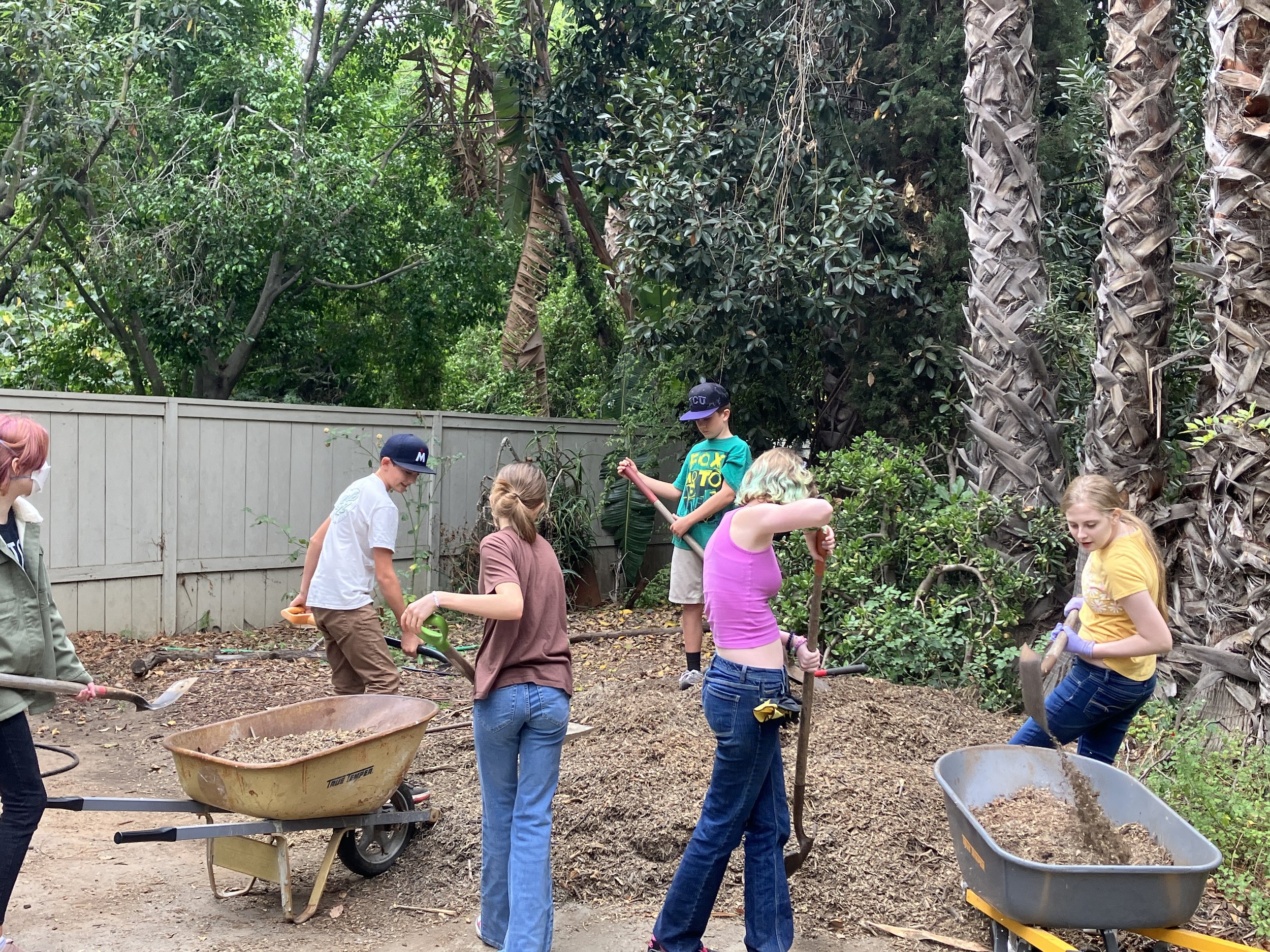
Below left, students work together to spread mulch on Farm School paths and learn how mulch nutures the soil, reduces soil temperature, slows down rain run-off and increases the water retained in the soil.
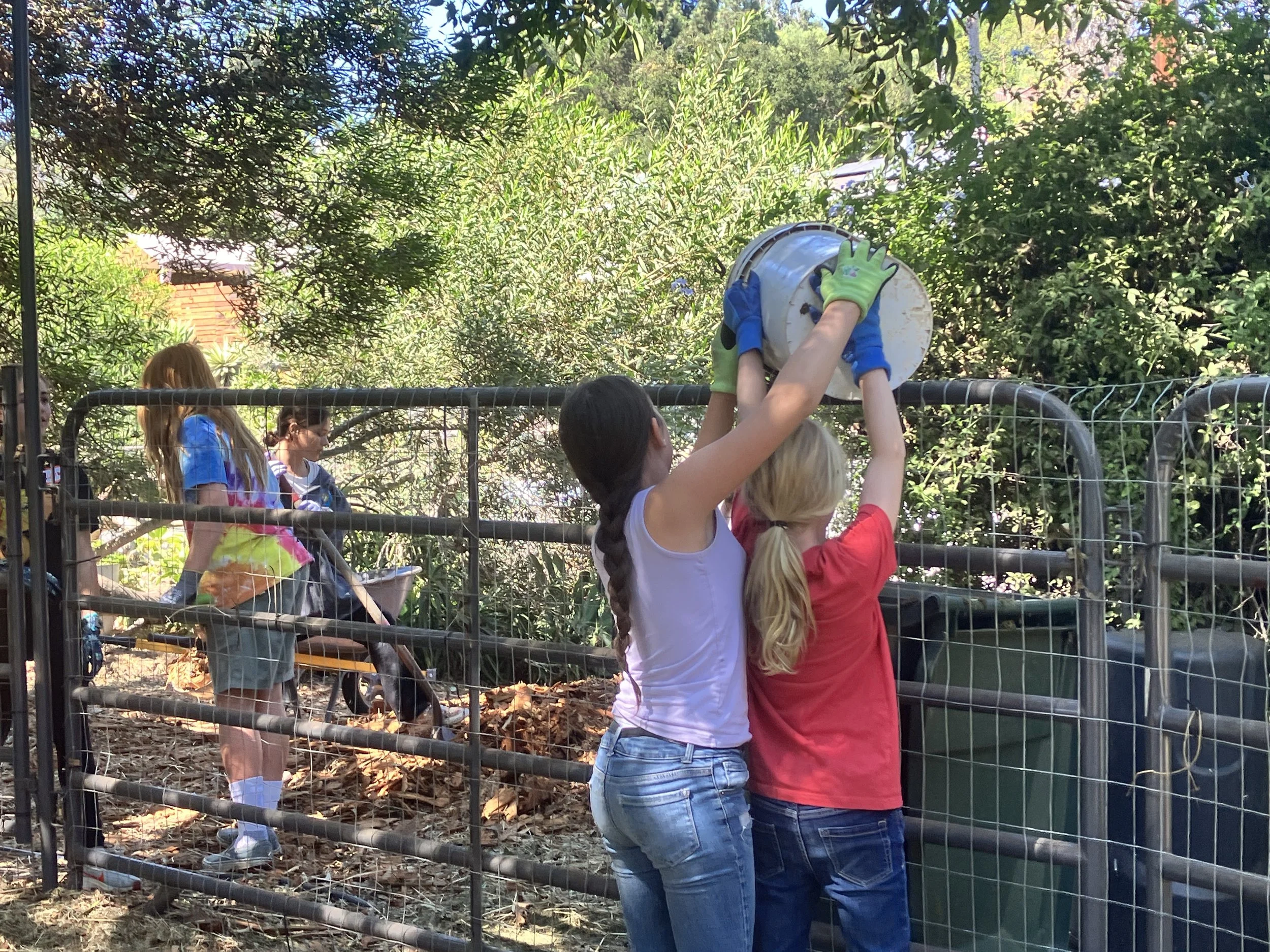

Some years students build a pond from the ground up and learn how the wetland bog they are planting is a vital part of the nitrogen cycle keeping the fish from being poisoned by the ammonia in their own waste. (Above right). Or prepare cattle corrals or a safe place for the mama cow to deliver her calf.
Other years students plant trees, pasture, shrubs for the animals to eat and the complex food webs both above ground and in the soil. Or assist with roofing Duckingham Palace for a the ducks or pigs or whatever creature is going to inhabit that space.
What students DO and LEARN each year depends upon both what the students are interested in that year AND what is happening on our micro-farm.

Public Speaking: Student presentations 2023 on science topics
Gathering around the fire on a winter day.

Prerequisites, Ages, Pricing

-
5th through 8th grade.
5th graders should be mature, with excellent self-regulation.
-
SCIENCE MATURITY
This is a small farm. On farms, animals mate.
Students should have a rudimentary understanding of animal reproduction: male and female mammals mate to pass on genetic information to their offspring via sexual reproduction.
We don’t discuss the mechanics of reproduction but on a farm and in nature in general, they may witness mating behavior of ducks, cattle, rabbits, insects.
READING
I use cursive in my as I write on the document camera so students should be able to read a combination of cursive and printing.
WRITING
Students need to be able to take notes during science lectures.
SELF-REGULATION
Students should have the self-regulation to safely participate in an outdoor learning and to discuss animal reproduction and birth.
-
2026-27 $400 per semester. Each semester is 8 weeks. Class is 2 hours long.
This class is smaller — 10 or fewer students per section with the two sections of RLFS will overlap so they have a larger cohort for recess and direct instruction/written work time.
-
Private funds: cash or check payable to Lisa Clark-Burnell.
Private payment may be divided into 2 installments due August 10, & October 10 for fall semester and December 15 and February, 1st for spring semester.
Charter School Enrichment orders are accepted. EOs are should be placed by August 1st (exceptions for DCS which starts its school year later).
Vendor: I am a vendor with Pacific Coast Academy, Mission Vista Academy, Cabrillo Point Academy and Dimensions Collaborative School, Freedom Academy of Literacy First Charter School, and SoCal Scholars Academy.
-
Relevant Education and Experience
I have a BA in English and Political from UC Santa Barabara. While an undergraduate, I served as writing tutor for graduate and undergraduate students assisting them with writing assignments in all disciplines. Upon graduating with highest honors and being recognized as one of the top three women in the humanities at UCSB, I then earned a CLAD multiple subject teaching credential with supplementary authorization in Social Studies and Language Arts from San Jose State University. In 1996 I began teaching mostly middle schoolers (but some high school students during the summers when I taught algebra at The Menlo School) language arts, history, and math first in Cupertino and Sunnyvale in the Bay area and then in Carmel Valley at San Dieguito Union High School District. I was the 6th grade GATE teacher as well as partnered closely with our SPED resource teacher for my 8th grade core classes. I was invited to participate in the San Jose Writing Project and while at these middles schools concentrated on designing language arts and history curriculum.
In 2005 I took a hiatus from teaching middle school to stay home with my children. During that period, I co-founded and directed Salem Harvest, a non-profit that connects farmers and backyard growers with volunteer pickers to harvest fruits and vegetables that would otherwise go to waste in an effort to end hunger. I also began building on my childhood experiences growing up on a micro-farm, honing my organic gardening expertise and animal husbandry skills and diving deep into permaculture. In 2012 I returned to teaching but this time as a homeschooling parent.
In 2019, at the request of my own kids and other parents, I started teaching classes in my areas of expertise for other homeschool students.
For more information about Farm School and its orgins, see the About page.
Hands on zoology: Rabbit Coat Color Genetics
What better way to learn about heredity and Mendelian genetics than to breed Holland Lops? Punnett squares are much more interesting when you’re talking about alleles of Maude the chinchilla dam and Sabretache Von Moustache the broken black tort sire. Besides, these are offspring you can cuddle. Mendel’s peas or fruit flies can’t compete.







How is In Real Life Farm Science different from the Science & Language Arts class?
Just science.
No English Language Arts. No homework.
What does this class have in common with the longer Science & Language Arts seminar?
Interesting zoology & botany activities
In-depth lectures with note taking
7-8th grade-plus science content
Review games and quizzes
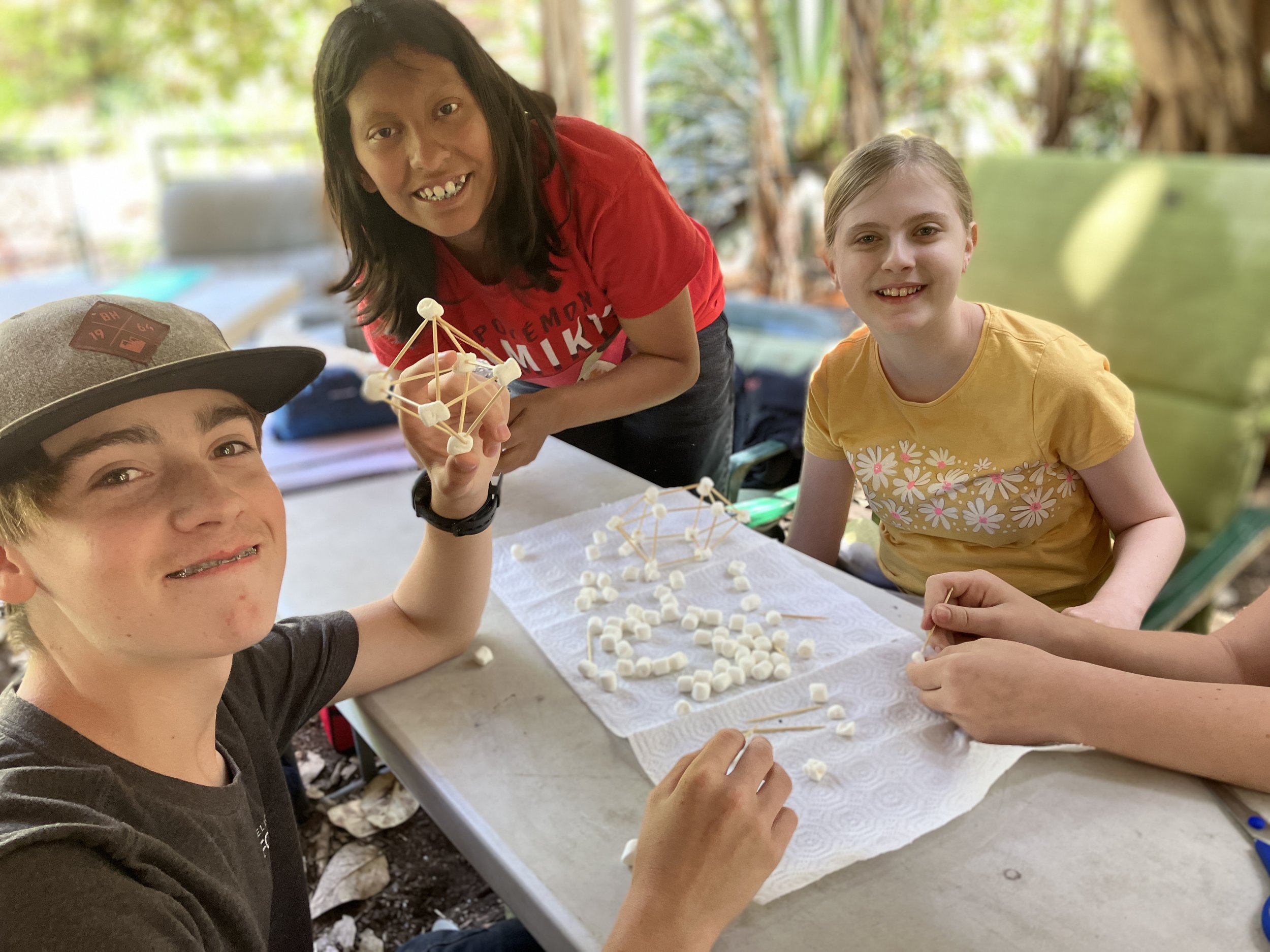
Hands-on activities. Examples: building model of cells, if studying ruminant anatomy, then feeding the cattle and handling them to understand physiological adaptations to natural diet and impact on animal health of different feeds in captivity.
Animal husbandry opportunities through farm work
How is this different from Science & Language Arts?
In Real Life Farm Science is 2 hours whereas Sci-LA is 4 hours
In Real Life Farm Science is open to 5-8th graders whereas Sci-LA is for slightly older kids 6-9th grades
Just science. No English Language Arts component.
No homework.